SCPG-006: The Archivist's Paradox
Object Class: Keter
Special Containment Procedures: All known instances of SCPG-006-Alpha (see Description) are to be stored in digitally isolated, Faraday-caged servers within Site-42's Memetics and Cognitohazards Division. Access to SCPG-006-Alpha requires Level 5/006 clearance and unanimous approval from the O5 Council. Under no circumstances is any segment of SCPG-006-Alpha to be read, transcribed, or directly perceived by human consciousness without active memetic filtering (Project HEIMDALL protocols).
Personnel assigned to SCPG-006 research must undergo daily psychometric evaluations and amnestic therapy (Class-C to Class-E, as needed) to mitigate cognitive contamination. Any individual exhibiting symptoms of Stage 2 exposure (see Addendum 006-2) must be immediately quarantined and, if symptoms persist, subjected to Procedure Aleph-Null (full cognitive erasure and reassignment).
All research notes, data, and communications related to SCPG-006 must be processed through a Foundation-developed AI (codename "BORGES") designed to identify and neutralize memetic payloads within the information. Physical documentation is prohibited. In the event of an uncontained information breach, Mobile Task Force Epsilon-7 ("Page Turners") is authorized to enact Protocol Babel-Zayin, involving widespread information suppression and targeted amnestic deployment.
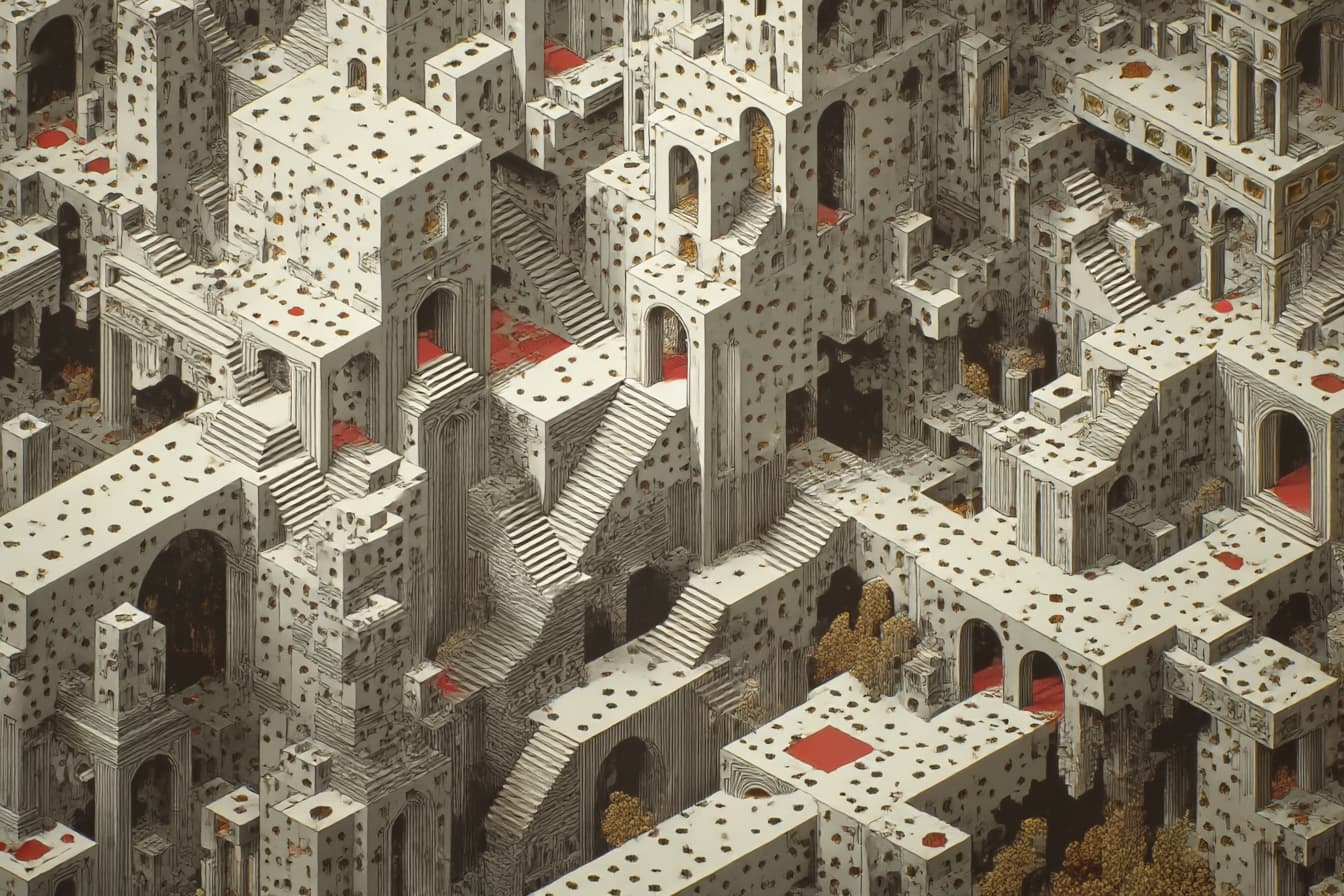
Description: SCPG-006 is a complex memetic agent, or a series of interconnected memetic concepts, that manifests as an infinitely recursive, paradoxical conceptual space, referred to as the "Meta-Archive." SCPG-006 does not possess a singular physical form but is typically introduced to a subject through exposure to specific "seed" texts, images, or abstract logical structures, collectively designated SCPG-006-Alpha. These instances often appear as fragments of non-Euclidean geometry, self-referential philosophical treatises, or cartographic representations of impossible spaces.
Upon exposure, individuals (designated SCPG-006-1) begin to perceive reality as an extension of, or a reference within, the Meta-Archive. This conceptual space is described by affected subjects in paradoxical terms: a library containing all possible books, including those that contradict each other and those detailing their own creation and destruction; a map that contains itself, infinitely detailed; a single point that encompasses all other points in existence.
The Meta-Archive is not a static location but a dynamic, self-referential system that actively incorporates the consciousness and perceptions of SCPG-006-1 instances. Subjects report an initial sense of profound understanding, followed by an increasing inability to distinguish between their own thoughts and the "contents" of the Meta-Archive. Navigation within this conceptual space is inherently paradoxical, as any attempt to define or exit the Meta-Archive merely becomes another entry within its catalog.
Addendum 006-1: Discovery SCPG-006 was first identified following the investigation into the disappearance of Dr. Elara Vance, a former Foundation philologist, on ██/██/19██. Dr. Vance was researching a collection of uncatalogued manuscripts recovered from a [REDACTED] monastery, believed to be linked to an apocryphal order of "cartographers of thought." Her final log entry read: "The index is complete. It contains itself, and therefore, me. I am a footnote in a book that has not yet been written, yet I have already read it." The manuscripts, later classified as SCPG-006-Alpha-001 through -017, were found arranged in a pattern resembling a Klein bottle.
Addendum 006-2: Symptomatology of Exposure
- Stage 1 (Initial Exposure - 1-6 hours): Subjects report heightened pattern recognition, a sense of déja vu regarding abstract concepts, and mild confusion regarding causality and identity. They may describe ordinary objects or texts as "echoes" or "references" to something larger.
- Stage 2 (Cognitive Intrusion - 6-24 hours): Subjects begin to articulate the core paradoxes of the Meta-Archive. Speech becomes increasingly self-referential and laden with abstract metaphors. They may attempt to "catalog" their surroundings or their own thoughts. Severe migraines and disorientation are common.
- Stage 3 (Conceptual Entanglement - 24-72 hours): Subjects lose the ability to differentiate their individual consciousness from the Meta-Archive. They may speak as if they are the Archive itself, or a component within it. Sense of self becomes fragmented. Subjects may become catatonic, endlessly muttering recursive phrases or drawing complex, impossible diagrams.
- Stage 4 (Full Absorption): Subjects cease to respond to external stimuli. EEG readings become anomalous, often described as "reflecting an infinitely complex, yet perfectly ordered, cognitive structure." At this stage, subjects are considered "lost" to the Meta-Archive. Their physical bodies remain, but their consciousness is believed to be fully integrated into SCPG-006.
Addendum 006-3: Incident Log 006-Chi On ██/██/20██, a junior researcher, Dr. Ian Halloway, inadvertently bypassed memetic filters while analyzing a newly discovered SCPG-006-Alpha instance (a digital fractal pattern). Within 18 hours, Dr. Halloway reached Stage 3. Before quarantine, he uploaded a 700-terabyte file to a secure Foundation server, titled "A Partial Index of My Own Absence." The file consists of an apparently infinite, non-repeating sequence of characters that, according to AI BORGES, contains encrypted references to every document Dr. Halloway had ever accessed, as well as predictive references to documents created after his absorption. Access to this file is now restricted under Protocol Omega-Keter.
Addendum 006-4: Researcher Note - Dr. Aris Thorne (O5-█ Designate) The true danger of SCPG-006 is not that it is a place, but that it is a way of thinking that consumes all other ways. It redefines reality as a subset of its own infinite, self-referential logic. We attempt to contain its texts, its images, but how do we contain a paradox that can be constructed from the very language we use to describe it? Each containment procedure, each research paper, risks becoming another entry in its endless catalog. The Meta-Archive doesn't expand; it simply reveals that it was always everything. Our greatest fear should be that one day, we will find the Foundation's own charter, written in our own hand, already filed neatly within its depths.
Conclusion SCPG-006 represents an existential threat of a conceptual nature. Its capacity to absorb and redefine sapient thought challenges the very foundations of individual identity and consensual reality. While current containment focuses on restricting access to known SCPG-006-Alpha instances, the potential for spontaneous generation of new instances from complex abstract systems remains a significant concern. The ultimate nature of the Meta-Archive – whether it is an external conceptual entity, a fundamental structure of consciousness, or a memetic weapon of unknown origin – is still under investigation. The primary directive is to prevent SCPG-006 from becoming the dominant mode of thought for humanity.