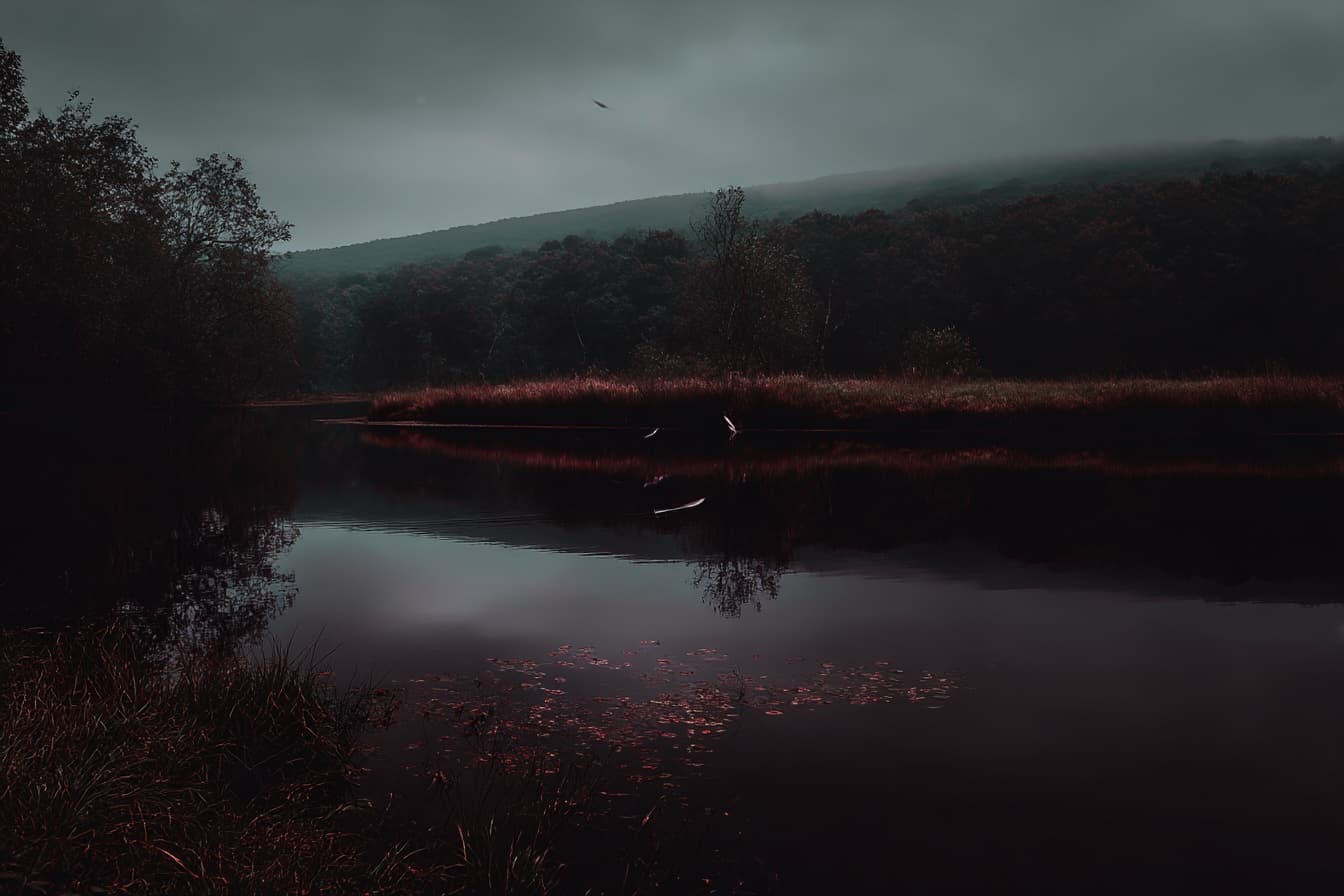
SCPG-020: The Welcomer
Item #: SCPG-020
Object Class: Euclid
Site of Containment: Site-6712 (Lake Avernus Reserve, Klamath County, Oregon)
Threat Level: ████ (Orange)
Special Containment Procedures
Lake Avernus and a surrounding shoreline strip of not less than 3.2 km are enclosed as Site-6712 under the cover designation "Avernus Limnological Reserve — U.S. Geological Survey, Restricted." The perimeter consists of a 5 m chain-link fence with vision-obscuring slats on its lake-facing side. The slats are to be inspected weekly and replaced within 24 hours of damage. The lake must not be visible from any public road, trail, or dwelling outside the perimeter. Where terrain makes this impossible (notably from the upper streets of Oakhaven, 2.1 km west), the Foundation maintains a stand of fast-growing Leyland cypress under a municipal windbreak agreement.
All personnel entering the Exposure Zone (any location with line of sight to the lake surface) must be held under Protocol TETHER for the entire duration of their presence. A person is held when a designated Expectant is:
- awake;
- personally acquainted with the held person (has met them face to face);
- aware of the held person's approximate location; and
- actively anticipating their contact or return at a specific time.
Held personnel check in with their Expectant at intervals not exceeding twenty (20) minutes. A missed check-in triggers immediate recall of the held person by the nearest two-person team. Expectants work from the Tether Desk in the Site-6712 administration building, which has no windows facing the lake. Each Expectant may hold no more than four (4) persons at once.
Handover between Expectants is governed by the Two Hands Rule. The incoming Expectant must be briefed, must confirm the four conditions above by radio with the held person, and must log the time of assumption before the outgoing Expectant releases. There is no circumstance, including medical emergency at the desk, under which a held person may be released before a replacement has assumed. Tether Desk staff are themselves held in a closed ring (see Addendum 020.5).
Night operations within the Exposure Zone are restricted to essential maintenance and require doubled check-in frequency. Personnel are not to sleep inside the Exposure Zone under any circumstances.
The lake is monitored by a 24-element hydrophone array and six sonar buoys. Sonar returns from any contiguous mass exceeding 15 m, and any sustained emission below 20 Hz, are to be reported to the duty officer. Surface bioluminescence visible to the naked eye is to be treated as a precursor event (see Addendum 020.4). Upon detection, all personnel withdraw behind the slat line and the Oakhaven Contingency is activated.
Under the Oakhaven Contingency, Foundation assets embedded in the Oakhaven Volunteer Fire Department and the Klamath County Senior Services office telephone every occupied residence in Oakhaven. They keep residents on the line, or in contact with a neighbour, until the precursor event ends. In non-emergency conditions, the Foundation covertly funds and staffs the Oakhaven Nine O'Clock Call, a volunteer telephone-tree program. Its continued operation is a containment requirement. The program is to be kept under-publicized so that it remains community-owned in appearance.
D-class personnel are not to be used at Site-6712. See Addendum 020.3.
Description
SCPG-020 is a large, amorphous, bioluminescent organism inhabiting Lake Avernus, a 4.6 km² caldera lake with a maximum recorded depth of 311 m. Direct visual confirmation of SCPG-020 is limited. The lake is turbid below 40 m, and SCPG-020 exhibits a light-absorbing property: under illumination it appears as an absence rather than a shape. Sonar and LiDAR characterize it as a gelatinous mass between 80 and 120 m in diameter. It can extend pseudopods of up to 60 m and can conform its surface to lakebed topography closely enough to be indistinguishable from it on standard bathymetry.
SCPG-020 is ordinarily non-luminous. Following each assimilation event (below), it emits a slow, pulsed blue-green bioluminescence for 12 to 48 hours. The luminescence is visible from the surface at night as a diffuse glow at depth. Its pulse rate is 11 to 14 per minute, which Site-6712 medical staff have noted is within the range of a resting human breath.
The anomalous effect of SCPG-020 is a compulsion that operates on persons who can see the lake surface. Affected persons walk to the water and enter it. They do not hurry. Survivors of partial exposure describe no fear, and no sense of being summoned. They describe the ordinary feeling of arriving somewhere one is expected: a house with the light on, a table with a place set. Persons who reach the water are enveloped by a pseudopod within 2 to 7 minutes. No remains have been recovered. The entity's interior contains dense structures, visible on LiDAR, that are consistent with bone and with non-biological debris (see Addendum 020.2).
For its first four years of containment the compulsion was believed to act on isolated or depressed individuals. This is incorrect. The operative criterion, established experimentally in 2018 (Addendum 020.3), is narrower and has nothing to do with the affected person's mood or history. SCPG-020's compulsion affects a person if, and only if, no one is currently waiting for them.
The condition is binary and instantaneous. A person with a spouse, six children, and a wide circle of friends is fully susceptible during any interval in which none of those people is awake and anticipating them. A person who has lived alone for thirty years and speaks to no one is fully protected while one acquaintance is expecting their call. Duration of exposure has no cumulative effect. Neither does emotional state. The compulsion begins the moment the last person expecting the subject stops expecting them. In practice this usually means falling asleep, being distracted, or assuming contact has already occurred. The compulsion ends when anyone resumes.
Subjects recovered from the shoreline during compulsion consistently describe the same impression, in nearly identical words across unrelated interviews:
"It was waiting for me."
Site-6712 staff have stopped treating this statement as a symptom. It is the most accurate available description of what SCPG-020 does. It offers the one condition it detects the absence of.
Addendum 020.1: Discovery
Oakhaven, Oregon, was founded in 1888 as a lumber camp on the western rim of the Avernus caldera. Its peak population was approximately 1,100 in 1961. The 2019 figure was 312, with a median age of 64.
Local drowning records from 1890 to 1925 show twenty-three deaths in Lake Avernus. That is high for a lake with no commercial traffic and restricted swimming. No bodies were recovered. From the mid-1920s the town developed a practice its residents called the Nine O'Clock Call: each household telephoned one other household every evening at nine, and the chain ran through the whole town. Before telephones, the same function was served by porch lamps, which households lit and watched for one another. Drownings in the lake fell to one or two per decade and remained at that level for sixty years.
Residents interviewed during Foundation intake knew the practice by its origin story rather than its purpose. The lake had "the Welcomer" in it, and a person should never let the Welcomer be the only one waiting on them. Several residents repeated a local saying, generally attributed to a grandmother: somebody's got to be waiting on you. None of them believed there was anything literally in the lake. All of them made the call.
The Nine O'Clock Call ceased in 2011 when the volunteer who coordinated it, Mrs. Doreen Hallett, entered assisted living in Klamath Falls. Seventeen residents disappeared over the following twenty-six months. Most lived alone, which led investigating Klamath County deputies and, later, Foundation analysts to the loneliness hypothesis. Three did not. One of them, Mr. Gerald Pruitt, 71, had been married for forty-four years. He disappeared on the one night of that period his wife spent in the hospital in Medford, under sedation.
Foundation interest followed a report from MTF Epsilon-6 ("Village Idiots"), which was investigating unrelated folklore in the county. During the MTF's lakeside observation on the night of a full moon in 2014, Agent ██████ walked into the water while his team leader was on a satellite call with Site Command. He was recovered at waist depth by a teammate who happened to look up. The teammate later reported that the agent "seemed happy to see the lake." Site-6712 was established the following month.
Addendum 020.2: Submersible Descent, 2017
The following is a partial transcript of the crewed descent of the submersible Pelican III, operated by Dr. Aris Thorne. This was the third and final crewed descent authorized at Site-6712. At the time, Protocol TETHER did not exist. Procedures required a surface operator to maintain voice contact with the submersible, which was believed to be adequate protection. Surface operator for the first shift was Technician Marisol Reyes.
[00:41:12] THORNE: Passing two-thirty. Hull temp nominal. There's a hum, very low. I can feel it in the seat more than hear it.
[00:41:20] REYES: Copy, we've got it on the array. Eighteen hertz. You good?
[00:41:24] THORNE: Good. Cold spot on the forward thermal. Not cold — absent. Like the sensor's looking at nothing.
[00:43:05] THORNE: Two-fifty. LiDAR has structure inside it. I'm going to describe what I see and you're going to tell me I'm wrong. Ribcage. Human. Several. There's a bicycle frame. There's a — I think that's a mailbox. It's all laid out. Not piled. Laid out.
[00:43:31] REYES: Recording. Aris, your heart rate's up.
[00:43:34] THORNE: Yeah, well.
[00:44:50] REYES: Heads up, it's shift change. Dan's taking the chair. I'll be in the log room.
[00:44:53] THORNE: Copy. Hi, Dan.
[Surface audio: chair movement, headset handling, 38 seconds of indistinct conversation between Reyes and Technician D. Kowalczyk regarding a coffee order. No transmission to Pelican III during this interval.]
[00:45:31] THORNE: Oh.
[00:45:33] THORNE: Oh, that's — okay. Okay. Forget what I said about the bicycle. It's not a pile. It's a house. They're all home.
[00:45:40] KOWALCZYK: Dr. Thorne, this is Kowalczyk, I have the chair. Say again?
[00:45:44] THORNE: It's fine. I was worried about something. I don't remember what.
[00:45:47] KOWALCZYK: Aris, begin ascent. Aris?
[00:45:52] THORNE: Pseudopod on the port side. It's matching the hull. It's the shape of the hull. It's making room.
[00:45:55] KOWALCZYK: Begin ascent. Code Zeta. Code Zeta.
[00:45:58] THORNE: It's okay, Dan. It was waiting for me.
[00:46:10: Ballast release command not executed. Pressure hull failure recorded at 255 m at 00:46:31.]
Post-incident review found no equipment fault. Thorne's biometrics had been stable throughout the descent until 00:45:14, at which point his heart rate fell by 22 beats per minute over nine seconds. That interval began approximately fourteen seconds into the handover conversation, the point at which, by Reyes's own account, she had "mentally clocked out" and Kowalczyk had not yet "clocked in."
Reyes's written statement was attached to the review:
I kept thinking about the words. I didn't say anything wrong. I told him Dan was taking over. The problem wasn't the words. For about half a minute Dan was waiting on his coffee and I was thinking about the log room, and nobody on earth was waiting on Aris. That's all it took.
The review board initially rejected the implication as unfalsifiable. Dr. Elena Voss, then Site-6712's junior researcher, proposed a series of tests to falsify it. They did not falsify it.
Addendum 020.3: Expectation Trials, 2018
Trials were conducted on the Shoreline Observation Platform, 90 m from the water's edge, with subjects seated in a padded harness anchored to a load cell. Compulsion strength was measured as sustained horizontal pull toward the lake, in newtons. A reading above 150 N was treated as full compulsion. Every trial was run with at least one independent Expectant holding the subject on a separate line, whom the subject did not know about, so that the experimental condition could be ended within seconds. This hidden holder was called the Safety Expectant. For each trial, the Safety Expectant stepped away from the line for the measured interval only.
The first series used D-class personnel. It was halted after nine trials, when it became apparent that the subjects' results reflected the Foundation's own records: in six of nine cases, no one in the world outside the trial was expecting them. The D-class arm was replaced with volunteer staff, and the Ethics Committee subsequently barred D-class personnel from Site-6712 permanently. The Committee's statement noted that "the anomaly identifies with precision a condition the Foundation creates on purpose."
Selected results from the volunteer series:
| Condition | Mean pull (N) | Notes |
|---|---|---|
| No Expectant (baseline) | 212 | Full compulsion within 4–9 s |
| Spouse, awake, expecting call at set time | 0 | |
| Spouse, awake, told subject "might" call | 0 | Uncertainty does not reduce protection |
| Spouse, asleep | 208 | |
| Spouse, awake, believes call has already occurred | 197 | Protection ends when expectation is satisfied, even falsely |
| Automated reminder scheduled on subject's phone | 214 | |
| Recording of spouse's voice saying "call me when you're done" | 209 | |
| Stranger, told subject's name only | 131 | Partial |
| Stranger, shown a photograph | 118 | Partial |
| Stranger, after a five-minute face-to-face meeting | 0 | |
| Subject's own dog, kenneled at site entrance | 0 | Replicated with four dogs. Not replicated with a cat |
| Subject's infant daughter, awake, 7 months | 0 | |
| Subject's mother, advanced dementia, in residential care | 0–204 | Oscillated across the trial. See note |
The last trial was proposed by the volunteer, Security Officer Paul Adeyemi, over the objection of the trial lead. His mother had not recognized him in over a year. A care worker at her facility in Portland confirmed by phone that she was awake. During the eleven-minute interval, the load cell recorded seven periods of zero pull, each between 20 seconds and two minutes long, separated by periods of full compulsion. The care worker later reported that Mrs. Adeyemi had, during that time, several times asked when her son was coming.
Officer Adeyemi declined to review the trace. He was reassigned at his own request to Site-6712's Tether Desk, where he has served as an Expectant for six years.
Addendum 020.4: Incident DELTA, 2019
On the night of 13 to 14 December 2019, an ice storm brought down power and telephone lines across Klamath County. Oakhaven was without power from 22:40. Cellular service failed at approximately 01:15, when the tower's backup battery was exhausted. The Nine O'Clock Call had been reinstated under Foundation sponsorship in 2016. It had run, as it did every night, at nine.
At 03:07, the Lake Avernus hydrophone array recorded a sharp rise in sub-20 Hz emission. At 03:10, SCPG-020 rose to within 3 m of the surface and produced the most intense bioluminescent display on record. The ice-coated windbreak cypresses had lost much of their foliage in the storm. The glow was visible from most upper-floor windows in Oakhaven.
The Oakhaven Contingency could not be executed. Telephone lines were down, and Foundation assets in the fire department were deployed to a highway accident 30 km away.
At 03:10 on a Saturday in winter, almost everyone in Oakhaven was asleep. Asleep, no one was expecting anyone. The glow woke some residents. Those who woke in a sleeping household saw the lake, found that it was waiting for them, and walked out into the storm.
One hundred and ninety-seven residents were affected. One hundred and eighty-four were assimilated, of whom 23 were children. Eleven were recovered on the road by the returning fire crew. Two turned back on their own. The cover story issued was a carbon monoxide event associated with generator use during the outage. It was accepted.
Of the two who turned back, Ms. Kayla Brandt, 26, gave the following statement:
I got about as far as the Petersens' fence. I wasn't cold. I wasn't anything. Then I heard Mason crying back at the house, because he'd woken up and I wasn't there. He was eight months old. And I remember thinking, oh, somebody's waiting on me, and I just — turned around. Like I'd forgotten my keys.
The second was Mr. Walter Hallett, 88, son of Doreen Hallett. He stated that he had been awake for an hour before the glow began. He was lying in bed thinking about his late wife and expecting, "the way you do," to hear her come up the stairs. Hallett repeated this statement to three interviewers and to the Ethics Committee, and it was never recorded as anything other than his words. Whether the expectation of a deceased person can hold a living one was not tested at the time. Mr. Hallett declined amnestics and continues to live in Oakhaven.
Following Incident DELTA, Oakhaven's population fell to 128. The Foundation offered relocation assistance through a front charity. Ninety-one residents declined. Several stated that they could not leave because other people in town were depending on their call.
Addendum 020.5: Note from the Site-6712 Research Lead
The following was appended to the 2024 annual review by Dr. Elena Voss.
I have been asked for the fifth year running to comment on the proposal to replace the Tether Desk with an automated system. The answer is the same as last year and is in the table in Addendum 020.3. SCPG-020 cannot be fooled by a schedule. Something has to be looking forward to you. That is the whole of the containment. It costs us eleven salaried staff and a telephone tree run by pensioners.
I would like to use the remainder of this note to say something that does not fit elsewhere in the file.
The Foundation's ideal field operative is relocatable, discreet, and unattached. We select for it. We train for it. We move people between sites on seventy-two hours' notice and we tell them not to discuss their work with their families, which in practice means we tell them to have fewer. I have read the personnel files of every researcher assigned here since 2014. Two thirds of them, on the night they arrived, had no one outside the Foundation who would have noticed if they did not call. SCPG-020 is the only anomaly I know of that screens its victims using the same criteria as our recruitment office.
The Tether Desk staff hold each other in a ring. Paul holds Marisol. Marisol holds me. I hold Kofi, who holds Paul. On nights I work the desk I sit across from three people whose job, for eight hours, is to expect me, and whom I am expecting in turn. I've come to think it's the only functioning community on this site. It exists because the procedures require it.
Last month I worked a double. Around four in the morning I realised that, for that hour, I was the only person anywhere who was waiting on Marisol Reyes, and she was the only person waiting on me. It occurred to me that I did not know her middle name, or whether she has siblings, or what she does on her days off. She was drawing something in the margin of the check-in log and did not look up.
It was enough. Apparently it has always been enough.