SCPG-024: Let's Play a Game
Item #: SCPG-024
Object Class: Keter
Site of Containment: Site-87 (former Harlan Street Elementary School, Kingman, Arizona)
Threat Level: ████ (Red)
Special Containment Procedures
SCPG-024 is contained in situ. No attempt is to be made to enclose, cover, cool, relocate, disassemble, or demolish it. See Addendum 024.2 for the reasons.
A thermal exclusion zone of 60 m radius is maintained around the equipment footprint. Ambient temperature at the zone boundary typically ranges from 55 to 70°C. Personnel inside the zone must wear Class-IV aluminized proximity suits with active cooling, and exposures are limited to 25 minutes. The asphalt play surface on the zone's southern edge, designated the Apron, is exempt from the exclusion radius during scheduled recess periods (below). SCPG-024 has never raised the Apron's surface temperature above 48°C while a game is in progress.
SCPG-024 is to be played with twice daily under the Recess Protocol, at 10:15 and 14:30 Mountain Standard Time. These were the recess times of Harlan Street Elementary in its final academic year (1990–91), and each period lasts twenty (20) minutes. The recess bell, the school's original Edwards Adaptabel unit, is maintained in working order and must be rung at the start and end of each period. Recess is not to be skipped, shortened, or rescheduled for any reason, including weather, staffing, or budget review.
Recess is conducted by the Rules Committee, which consists of:
- one Chair, holding Level 3 clearance or above, with authority to make binding rulings during play;
- one specialist in children's folklore, with particular expertise in the playground games of the American Southwest, c. 1965–1990;
- one member of the Site-87 Legal Department;
- two to four Players, drawn from personnel who score in the top decile of the Childhood Recall Inventory (CRI-3).
The Committee reads any chalk inscription present on the Apron at the start of recess, determines the game proposed, rules on its rules, and plays it. All Committee members must be fluent in the regional conventions of playground law, including but not limited to truce terms, bounds, tag-back exemptions, calling "base," and the correct formulas for ending games. The Committee's running casebook of rulings (Document 024-R, currently 1,140 pages) is binding precedent for all future recess periods.
The following statements are prohibited within 100 m of SCPG-024 at all times, whether or not a game is in progress: "I'm not playing," "I quit," "this is stupid," "this doesn't count," "we're too old for this," and any equivalent. Personnel who make such a statement are to leave the zone immediately and report for thermal monitoring.
Personnel are reminded that the exposure effects described below include a tendency toward heated disputes over rules. Physical altercations during recess are to be broken up by the Chair, and the disputed point is to be settled by formal ruling, not by force. Two Players who come to blows are both considered out for the remainder of that period, which SCPG-024 has always accepted.
Description
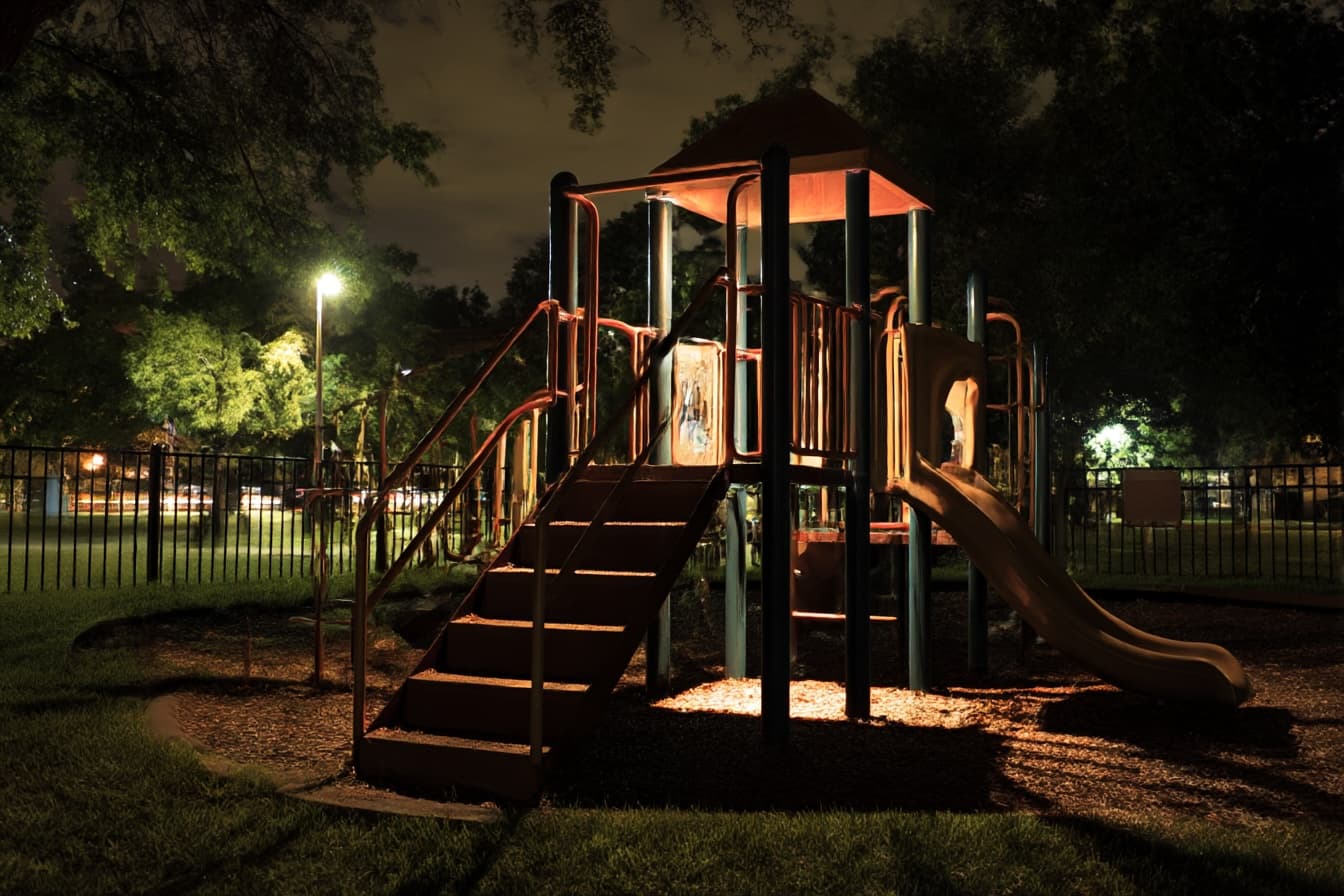
SCPG-024 is a set of steel playground equipment manufactured by Sunland Playworks of Phoenix, Arizona, and installed at Harlan Street Elementary School in 1972. It comprises a four-seat swing set, a seesaw, a set of monkey bars, a geodesic jungle-gym dome, a hand-powered merry-go-round, and a spiral slide 4.2 m high. Serial plates on all six pieces are intact and legible.
The equipment is incandescent. Surface temperatures vary from about 1,900°C on the swing chains to 2,510°C at the base of the spiral slide, which is the hottest point measured and is informally called "the core." The equipment glows white-orange by day and is visible from the Kingman interchange of Interstate 40 at night. The glow is attributed under cover story to a geothermal research installation. Structural steel of this grade should melt at roughly 1,450°C. SCPG-024 does not melt, deform, or oxidize. Its bolts remain torqued to 1972 factory specification.
The equipment moves as if in use. The swings swing with no occupant, in arcs consistent with a child of about 30 kg pumping their legs. The seesaw rises and falls. The merry-go-round turns in bursts, as if pushed and then ridden. Between recess periods, the pieces rearrange themselves across the footprint. The swing set has been observed at the far end of the field, and the slide in the middle of the Apron. These relocations take place only when unobserved and leave no scorching on the ground.
Messages written in coloured sidewalk chalk appear on the Apron. The chalk is commercially available calcium-sulfate chalk, principally in pink, yellow, and pale blue. No inscription has ever been observed while it was being made. Inscriptions are written in block capitals, and in the first decade of containment their spelling was consistent with a child of about seven. The first recorded inscription, and still the most frequent, is:
LETS PLAY A GAME
SCPG-024 is responsive to play. Its temperature falls when a game it has proposed is played fairly to completion, and rises when a game is refused, abandoned, or ended in a way SCPG-024 regards as a violation of its rules. Between recess periods the temperature rises slowly and steadily at a mean rate of 0.4°C per hour, which the Rules Committee refers to as boredom. The net trend since intake has been upward. Mean core temperature rose from 1,140°C in 1994 to 2,510°C in the most recent reading. Recess is the only known measure that slows the rise.
Persons within about 50 m of SCPG-024 experience a pronounced involuntary recall of their own childhood play: the sound and smell of recess, the textures of equipment, and above all the rules. Subjects recall the rules of games they have not played in decades with perfect clarity, including local variants and the precedents that settled disputes. Subjects also experience a regression in their attitude to rules. Arguments over whether a tag counted, whether a player was out of bounds, or whether a truce had been properly called become emotionally consuming. Adults with no history of violence have come to blows over them. These effects fade within about an hour of leaving the zone. The CRI-3, which measures the fidelity of a subject's childhood recall, predicts how strongly a person is affected. It also predicts how good a player they are. Players are therefore selected for the trait that makes the exposure worst.
Addendum 024.1: Discovery
Harlan Street Elementary closed in June 1991 because of falling enrollment, and its pupils were redistributed to two other Kingman schools. The building was leased to the county as storage. The playground was left in place pending a district-wide program to remove 1970s steel equipment. Such equipment was being replaced across the country after injury litigation, including a number of cases of children burned by sun-heated metal slides.
From the summer of 1992, neighbours made occasional reports of the swings moving on windless days. In July 1993 a school district facilities officer measured the slide's surface temperature at 81°C. He noted that this was within the normal range for an unshaded steel slide in a Mohave County summer and closed the complaint.
On 14 March 1994, a demolition contractor arrived to remove the equipment. At 10:15 the foreman, Mr. Ray Sandoval, told his crew, "All right, playtime's over," and a crew member began unbolting the first swing-set leg. The swing set reached incandescence within four minutes. The crew member's gloves ignited on contact, and he suffered second-degree burns to both hands. When the crew withdrew to the Apron, they found an inscription in pink chalk that none of them had seen arrive:
WE WERENT DONE
Foundation intake followed a Mohave County fire marshal's report. The first tests found the equipment at 1,140°C and cooling. A second inscription, found the following morning, read:
LETS PLAY A GAME
For the first seven years, the Foundation left this inscription unanswered.
Addendum 024.2: The LLCC Period and Incident 87-1
Between 1995 and 2003, SCPG-024 was contained under a policy of thermal suppression. The playground was enclosed within a Leidenfrost Layer Containment Chamber (LLCC). This was a 25 m geodesic dome of nickel-chromium alloy, lined with high-pressure water-mist emitters that maintained a vapour barrier between the equipment and the chamber walls. The Harlan Street school building was converted to serve as Site-87's administration, laboratory, and dormitory facility.
On the day the LLCC was sealed, the Apron (then outside the dome) bore the following inscription:
YOU CANT PLAY INSIDE ITS NOT RAINING
During the eight years of the LLCC's operation, core temperature rose at a mean rate of 0.9°C per hour, more than double the current boredom rate. The mist system was upgraded three times. Chalk inscriptions appeared daily on the Apron. From 2000 they consisted almost exclusively of the word PLEASE, repeated up to four hundred times in rows.
In October 2003 the Site Director, Dr. ██████ Crane, received a proposal from Researcher Luisa Ortega that the Foundation respond to the inscriptions. Dr. Crane's written response is preserved in the site file:
It is not a child. It is a thermal anomaly with a vocabulary. We are not going to play games with a Keter.
At 03:15 on 22 November 2003, the core temperature exceeded 3,200°C and the LLCC failed. The dome's vapour barrier flashed to steam, and the resulting overpressure destroyed the chamber and the eastern wing of the school building. The heat pulse extended about 1.2 km, ignited scrub brush across the hillside to the north of the site, and killed seven Foundation personnel, including Dr. Crane. The civilian population of the surrounding neighbourhood was evacuated under a wildfire cover story, and no civilian deaths occurred.
With the dome gone, core temperature fell by 1,600°C over the following 72 hours. On the fourth morning, the Apron bore the following inscription:
THATS BETTER
The Recess Protocol was drafted by Researcher Ortega and approved by the O5 Council within a month. The first recess was held on 5 January 2004, the first day of the Kingman school district's spring term.
Addendum 024.3: Selected Rulings from the Rules Committee Casebook
Recess 1 (5 January 2004). Inscription: LETS PLAY A GAME. After deliberation, the Committee drew a hopscotch grid in chalk on the Apron. Researcher Ortega threw a pebble and played. After her third turn, a second pebble, glowing faintly, fell onto square 6 from no visible source. Hopscotch was played in turns for the full twenty minutes. Core temperature fell by 41°C, the largest single-period drop recorded to that date. The next morning's inscription read AGAIN.
Recess 31. Inscription: SIMON SAYS TOUCH THE SLIDE. This was the Committee's first instruction that could not be safely obeyed. A proposal to touch the slide with a 10 m aluminium pole was rejected by the folklore specialist, Dr. Imogen Tate, who ruled that it would be regarded as cheating. The Committee instead invoked the playground-law principle that Simon may not issue an unsafe command, formally stated: "No fair! That's dangerous, you can't make someone do that." The Apron inscription changed while all five Committee members were looking in another direction. It now read OK FINE. SIMON SAYS HOP ON ONE FOOT. The Committee recorded this as the first evidence that SCPG-024 recognizes the jurisprudence of the playground and is bound by it.
Recess 58. Inscription: TAG YOUR IT. At the moment of reading, a small chalk handprint was found drawn on the asphalt directly beneath Player Denise Mahoney's left boot. The Committee ruled that she had been tagged. Mahoney could not tag SCPG-024 back. The Committee first cited the universal no-tag-backs rule as the reason. On reflection it also noted that doing so would have killed her. She tagged another Player, and tag continued among Committee members for the rest of the period. SCPG-024's merry-go-round turned continuously throughout, which the Committee interpreted as watching. Core temperature fell by 22°C.
Recess 77. Inscription: YOU HIDE I SEEK, followed by the numbers 1 to 100 written in sequence across the length of the Apron. The Committee asked where the bounds were, by writing the question on the Apron in chalk. The answer, THE FENCE, appeared at recess end. Hide-and-seek was scheduled for the following day under an emergency extension to 60 minutes, which SCPG-024 did not contest.
During the game, Players concealed themselves across the site. A region of heat shimmer, about 1 m tall, was observed moving across the field, pausing at hiding places. Each Player it located found a small scorch mark in the shape of a child's handprint on the nearest surface, on average within 30 cm of their head. Junior Researcher Paolo Lopez, concealed in a storm drain, was not located for 52 minutes. During the final 20 minutes, core temperature rose by 110°C. The Chair called the game with the correct regional formula, "Olly olly oxen free," and Lopez emerged. The next morning's inscription read:
NO FAIR YOU CALLED IT BECAUSE I WAS LOSING
The Committee reviewed the transcript and agreed, 4–1, that this was accurate. Core temperature had risen a further 180°C overnight. Recess 78 was spent on an apology, written in chalk, and a game of SCPG-024's choosing (hopscotch). The casebook entry for Recess 77 concludes: Adults are worse at this than we thought.
Recess 212. Two Players, Researchers ██████ and ██████, came to blows over whether a tag during Freeze Tag had landed before or after the victim had called base. The Chair declared both Players out. The swings, which had been still, swung for the remainder of the period. The Committee's ruling on the disputed tag (that it did not count) remains the precedent. Researcher ██████ has twice formally requested that it be revisited.
Recess 9,688. Inscription: RED ROVER RED ROVER SEND CHAIR RIGHT OVER. The Chair at that time was Dr. Tate. Red Rover requires the named player to run at a chain of joined hands on the opposing side. In this game the opposing side was the equipment footprint. The Committee held an emergency session over the recess bell, the only time the Protocol's twenty-minute limit has been used to defer a decision. It ruled, on Legal's motion, that SCPG-024 could not form a chain of hands because it had no teammates, and so could not field a side. The Committee wrote this on the Apron. The next morning's inscription read OK BUT THATS SAD, and the core temperature was 30°C lower than it had been at the close of the previous day.
Addendum 024.4: Note from Dr. Imogen Tate
Appended to the 2025 Protocol review. Dr. Tate has served on the Rules Committee since 2004 and as Chair since 2016.
For twenty years we have described SCPG-024 as a child. I wish to correct that, because it is not accurate any more.
The spelling has been improving. The file does not show this clearly because the casebook records games, not orthography, so I went back through the photographs. In 2004 there were no apostrophes and the phonetic spelling of a first-grader: WERENT, THATS, YOUR IT. By 2011 the vocabulary had doubled and it had begun writing in sentences. It also began proposing games with strategy in them, games in which you have to predict what the other player will do: capture the flag, and a version of Four Square with rules I had to look up. In 2019 it used a comma for the first time. In 2023 the letters became smaller and neater and ran along the edge of the Apron in a straight line, where before they had sprawled across the middle. It stopped using pink.
My professional field is the play of children between five and twelve years of age. One of the few things about it that is universally true is that it ends. Children do not stop playing because they are told to. They stop because one day the game no longer holds them, and they are embarrassed to be seen at it, and then they go home. The playground games of any given school are kept alive by a steady intake of seven-year-olds. Harlan Street has had no intake since 1991.
We have been keeping SCPG-024 cool by keeping it entertained. We do not know what it does when it is no longer entertained. Dr. Crane found out what it does when it is not allowed out to play. The two may not be the same, and I would rather not find out whether they are.
On 3 February this year, the inscription on the Apron read:
One more game, then I have to go home.
We have no idea what "home" means for an object of this kind at 2,510°C. The Metaphysics Department's projection of a full release of SCPG-024's accumulated thermal load is attached to this file as Document 024-Ω, restricted to O5 clearance. I have not read it. I have been told that I would not find it reassuring.
The Committee has considered this problem for seven months. The instruction that the next game be the last has so far been satisfied by the next game never finishing: we have not let a game run to its end since February. That device will not hold indefinitely. SCPG-024 has already begun to remark on it, in writing (YOU KEEP DOING THIS).
Our proposal, approved last week by the Site Director, is that we offer it a game that cannot end. We have chosen tic-tac-toe. Played competently on both sides it always ends in a draw, and a draw requires another round. It is the first game children learn is not worth playing. They usually learn it at about nine.
Addendum 024.5: Recess Log, September 2025
Recess 15,902. Committee drew a tic-tac-toe grid on the Apron. Chair played X in the centre square. An O appeared in the top-left corner while the Committee was consulting. Game ended in a draw after nine moves. A new grid was drawn. The first recess produced forty-one games, all drawn. Core temperature fell by 12°C.
Recess 15,903–15,911. Three hundred and eighty games, all drawn. Temperature stable to within 3°C. The Committee noted that SCPG-024 has not once played the wrong square.
Recess 15,912. Before the recess bell, the Apron bore a single line in blue chalk, written small and straight along the southern edge, correctly capitalized and punctuated:
This is boring.
Core temperature at the time of writing: 2,544°C and rising.