SCPG-025: Dark Notes
Item #: SCPG-025
Object Class: Euclid
Site of Containment: Site-17, Acoustic Containment Wing, Chamber AC-3
Threat Level: ████ (Yellow)
Special Containment Procedures
SCPG-025 is stored in anechoic Chamber AC-3 at Site-17. Its cylinder is immobilized by a felt stop wedge, and its governor is disengaged. The winding key is stored separately, in a locked cabinet in the Wing supervisor's office. The chamber is monitored by audio and video. Chamber microphones have never recorded anything anomalous and are retained for the video feed and as a matter of procedure.
No person may be present in AC-3 while the cylinder is free to turn except under the conditions of Addendum 025.4. Under no circumstances may SCPG-025 be played to fewer than four (4) listeners, or more than four.
Personnel designated SCPG-025-A through -D (Dr. Ravi Malhotra, Dr. Adaeze Okafor, Researcher Thomas Brierley, and Researcher Hannah Evans) are subject to the following:
- continuous cardiac telemetry, reviewed daily by Site-17 Medical;
- residence in Site-17 staff quarters, with sleeping quarters separated from AC-3 by no less than 200 m;
- no elective surgery, general anaesthesia, or travel beyond 50 km of Site-17 without approval from the Site Director and the Ethics Committee;
- immediate notification of Site Command in the event of any serious illness or injury to any one of the four.
Transfer, retirement, or resignation of any of SCPG-025-A through -D requires O5 review. See Addendum 025.5.
Description
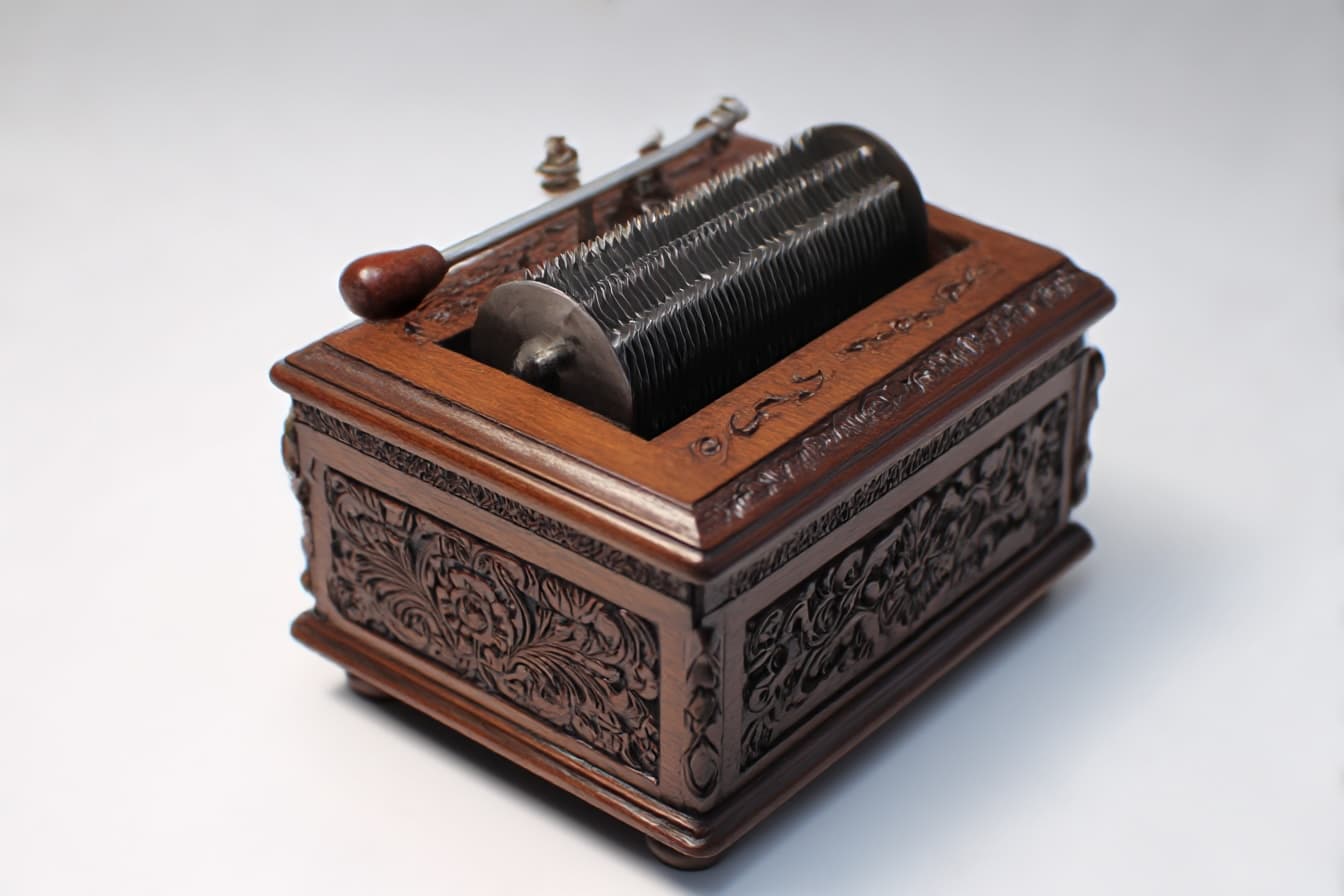
SCPG-025 is a cylinder music box made by the firm of Jaccard Frères of Sainte-Croix, Switzerland, in 1884. The case is mahogany, 20 × 15 × 10 cm, with a floral marquetry lid, and is in good condition. The mechanism is a standard Sainte-Croix pattern of the period: a pinned brass cylinder 6.2 cm long, a steel comb, a spring motor, and a fan-fly governor. When wound, the cylinder completes one revolution in about 48 seconds and plays a single air in D minor, 64 bars long, without accompaniment. The air does not match any catalogued work, published or unpublished, in the collections of the Musée CIMA at Sainte-Croix or the Foundation's Musicological Archive.
The steel comb of SCPG-025 was manufactured with 22 tooth positions. Four of them, positions 5, 9, 14, and 19, have no tooth. They were never there and did not break off: metallographic examination shows the comb was cut to this profile at the time of manufacture, with finished edges. The cylinder's pin tracks for all four missing positions are fully pinned. As the cylinder turns, those pins pass through empty air and strike nothing.
Listeners hear them anyway. At each point where a pin crosses an empty position, persons present hear a note of the corresponding pitch, in tune with the comb and with the timbre of a steel tooth. These are the dark notes. They do not reach any microphone and cause no vibration in the chamber air. Recordings of SCPG-025 play the air with gaps in it, which to trained musicians is audibly incomplete. Laser vibrometry of listeners during exposure, however, shows each dark note as a sympathetic resonance within the listener's body. It is sometimes centred in the skull, sometimes in the sternum or abdomen, and in one recorded case in the listener's teeth.
SCPG-025 plays its missing notes on whoever is listening.
The effects on the listener depend on how many listeners are present. SCPG-025 appears to divide the four missing tooth positions among them as evenly as it can. A single listener must sound all four, including chords in which two or three dark notes coincide. The resulting resonance is severe and has produced migraine, vomiting, vertigo, rupture of the tympanic membrane, loss of consciousness, and, in one historical case, cardiac arrest. The same reaction was described in the original file as unpredictable and "without pattern." It was not unpredictable. It varied with the number of people in the room, which the original testing protocol did not record.
With two listeners, each sounds two notes and experiences moderate discomfort. With three, the load is uneven: one listener sounds two notes, and experiences mild discomfort. With four, each listener sounds one note and experiences no ill effect of any kind. With five or more, the box plays with one or more listeners silent. Those listeners report hearing the complete air, and also report a feeling of exclusion so acute that two of them wept during testing. Five-listener trials have been discontinued.
SCPG-025 was made to be played by four people.
Addendum 025.1: Incident 025-04, 2008
On 18 April 2008, Researcher Hannah Evans wound and played SCPG-025 alone in AC-3 as part of the routine characterization then in force. At about 23 seconds into the first revolution, the first dark notes of the air sounded (positions 9 and 14 together, a minor third). Evans put her hands to her head, and at 31 seconds she began to vomit. At 90 seconds she lost consciousness, falling against the stop lever, which halted the mechanism. Medical staff stabilized her and transferred her to Site-17 infirmary, where she was found to have a perforated left eardrum.
Post-incident analysis of the chamber recordings found nothing out of the ordinary. The box played its air with its usual gaps, and nothing was heard in them.
After her recovery, Evans said that the notes "felt like nails on a chalkboard, but inside my skull, like I was the chalkboard." On the second day of her recovery she asked for a keyboard. She then played, from memory, four pitches that she said she had heard during the incident and that "didn't sound like the rest of the box." The pitches were A4, D5, F5, and C6. None of them corresponds to any tooth on SCPG-025's comb. All four correspond exactly to the pitches the missing teeth at positions 5, 9, 14, and 19 would have produced.
Evans subsequently requested reassignment from SCPG-025 research. The request was granted and later withdrawn (see Addendum 025.4).
Addendum 025.2: Research Log, Dr. Ravi Malhotra
2 May 2008. My note in the previous version of this file proposed that SCPG-025 was a "transdimensional" object whose effects bled into our reality at random intervals. I withdraw it. I wrote it before I had looked at the comb under a loupe, which I have now done, and which nobody had done in ten years of containment because the object's anomaly was assumed to be in the sound rather than the hardware.
There are four teeth missing from the comb. The pins for them are all there, bright and unworn, which on an instrument of this age is its own small horror. Hannah's four notes are the pitches those teeth would have played. I have been sitting in the office with that for an hour.
9 May. I am calling what the box does "sounding" the listener, for want of a better word. The vibrometry is unambiguous. When the pin for position 14 passes the gap, the listener's body sounds F5. It is the only instrument in the room that can.
22 May. Paired trials, with volunteers Brierley and me, seated two metres apart. We each heard the air with some of the gaps filled. I heard positions 5 and 14 and Brierley heard 9 and 19. Neither of us heard the other's notes. We each had a headache of the kind you get from a long, loud concert and nothing worse. Sixty seconds of the same exposure put Hannah in the infirmary.
We swapped seats, and the assignment did not change. Brierley still heard 9 and 19. It is not following where we sit. It is following us.
29 May. Three-listener trial (Brierley, Okafor, me). Okafor took position 19 from Brierley and I kept both of mine. Given how the notes are distributed through the air, I appear to have been assigned the heavier load, which is some consolation to Brierley.
I am more and more convinced that the box is not an object that harms people. It is an object that requires them, and it harms the ones it has too few of. The next test is obvious. I would like it on record that it was proposed by the same person who is about to ask to be in it.
Addendum 025.3: Provenance
The Foundation recovered the order ledgers of Jaccard Frères, which ceased trading in 1911, from the archives of the Commune of Sainte-Croix in 2009. The entry for SCPG-025 reads, in full (translated from the French):
No. 4417. Cylinder box, 22 blades, original air (to order), mahogany, marquetry lid. Delivered 3 October 1884 to M. Aurèle Vautier, Lausanne. Price 340 fr. Comb to be completed by the purchaser.
The note in the final line appears nowhere else in the ledgers of Jaccard Frères or of any other Sainte-Croix maker the Foundation has examined. The composer of the "original air" is not recorded. The firm's pinning notebooks for 1884 survive, and the page for No. 4417 has been removed.
The Vautier household at the time of purchase was M. Aurèle Vautier, a notary; his wife, Marthe; and their daughters, Isaline, 11, and Rose, 7. Parish and civil records, and a series of letters from Mme Vautier's sister, Mme Élise Demole, establish that the family played the box every evening after supper for about seven years. Mme Demole described it in an 1886 letter as "a strange little tune that I do not care for when I hear it alone in the parlour, but which is quite lovely when you are all together."
Rose Vautier died of diphtheria on 14 February 1891, aged 13. Mme Demole wrote to her husband on 2 March:
They have not stopped the box. Aurèle says it is a comfort and that it keeps her place at the table. They play it every evening still, the three of them, and I do not understand how they bear it, because it sounds very wrong now.
Aurèle Vautier died on 21 March 1891, Isaline Vautier on 27 March, and Marthe Vautier on 4 April. The attending physician recorded the cause of death in each case as "failure of the heart, following grief."
The box passed through an estate sale in 1892 and changed hands at least eleven times over the following century. The Foundation has found reports of an unexplained illness or death associated with it for five of those owners, all of whom appear to have lived or played it alone. SCPG-025 was acquired in 1998 from the estate of a collector in Basel, who was found dead in his music room with the box's governor still turning.
Addendum 025.4: Four-Listener Trial, 2009
On 16 June 2009, SCPG-025 was played to four listeners in AC-3: Dr. Malhotra, Dr. Okafor, Researcher Brierley, and Researcher Evans. Evans had withdrawn her reassignment request and asked to take part, stating: "I would like to hear what it was trying to do." The Ethics Committee approved the trial on the basis of the three-listener results. Its minutes note that no test had been conducted to establish what would happen after a four-listener exposure, and that none could be devised in advance.
SCPG-025 was wound and played for one revolution. The assignment of positions was Malhotra 5, Evans 9, Okafor 14, Brierley 19.
None of the four listeners showed any sign of distress. Cardiac telemetry recorded something not seen in any previous trial. At the start of the revolution the four listeners' heart rates were 71, 84, 66, and 78 beats per minute. Within the first 16 bars they had converged on 64 beats per minute, the tempo of the air. They remained in phase to within 20 milliseconds for the rest of the revolution.
Post-trial statements, excerpted:
Dr. Okafor: It's the first time anyone has heard it since 1891. That is the thing I keep coming back to. It isn't a strange tune at all. It's a lullaby. It's obviously a lullaby.
Researcher Brierley: I've never played an instrument. For forty-eight seconds I was one, and I was good at it.
Researcher Evans: Mine was the one that hurt me last year. It was my note. It didn't hurt at all. I think it only hurts when you have to be all of them.
Dr. Malhotra: It ends on a half-cadence, on the dominant, so it doesn't end. It's written so that it goes back to the start. That is how a music box works, of course. I would just like to note that it is also how this one works.
The four listeners' heart rates returned to their individual resting rates within an hour of the trial. On the night of 16 June 2009, the telemetry of all four recorded a period of about 48 seconds, beginning at 02:14, in which their hearts again beat in phase at 64 beats per minute. All four were asleep in separate quarters at the time. None of them reported having woken.
This has recurred every night since.
Addendum 025.5: Current Status
Since 2016, SCPG-025 has been observed to play without being wound. Each night at 02:14 the cylinder completes a single revolution against its felt stop, which it compresses without damage, while the governor is disengaged. The chamber microphones record the air with its gaps. At the same moment, SCPG-025-A through -D, wherever they are on Site-17, sound their notes. Since 2019 they have been awake for it.
All four have described the experience as painless and, in Brierley's word, "companionable." Dr. Okafor has asked that her statement on the matter be recorded as follows: "Every night, for forty-eight seconds, I know exactly where the other three are. Some nights I think it is the most intimate thing that has ever happened to me. Other nights I am frightened, and they are frightened too, and we all know it."
No member of the quartet has been more than 50 km from the other three since 2009. The Foundation does not know whether distance matters. It does know what happened to the Vautier family, and all four members of the quartet have read Mme Demole's letters. The Ethics Committee has classified a controlled test of separation as impermissible.
The four members of the quartet are now aged 67, 66, 52, and 43. It is expected that one of them will die before the others.
In 2024 the O5 Council approved an amendment to the containment procedures for that eventuality. If any member of SCPG-025-A through -D dies or is terminally incapacitated, a replacement listener is to be seated with SCPG-025 in AC-3 within forty (40) days, alongside the surviving members, and the box is to be played for one revolution. The forty-day figure is taken from the interval between the deaths of Rose and Aurèle Vautier. It is the only data point the Foundation possesses.
Site-17 Personnel maintains a standing list of candidate replacements. Candidates are selected for good cardiac health, for expected tenure at Site-17 of at least twenty years, and for having no dependents who would be affected by permanent assignment.
Candidates are not informed.
Dr. Okafor's request for retirement, submitted 11 March 2025, remains under review.