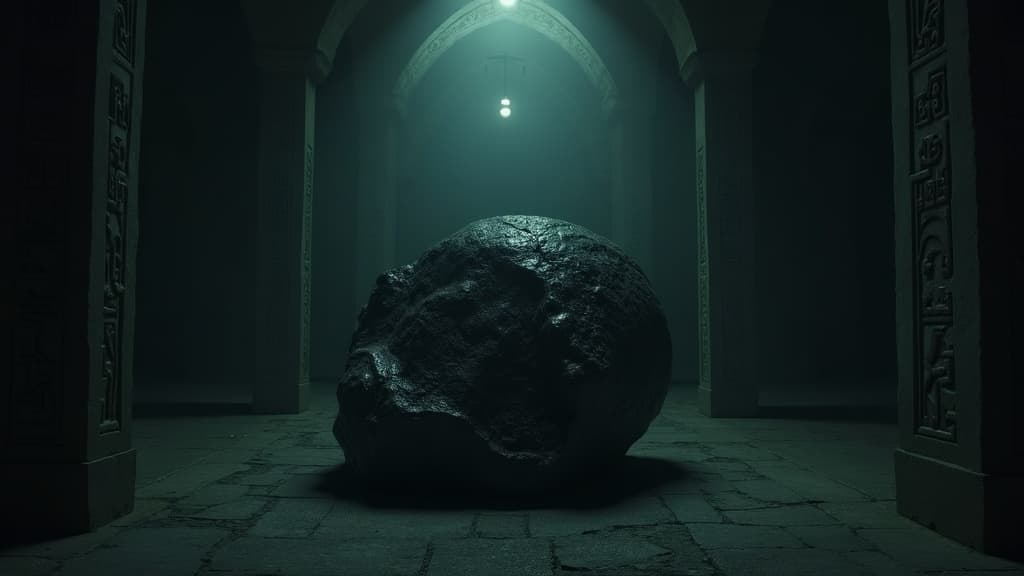
SCPG-035: The Architect's Remainder
Item #: SCPG-035
Object Class: Euclid
Special Containment Procedures: SCPG-035 is to be housed within a reinforced containment chamber (Designation: Site-88, Wing 7, Chamber 14-C) measuring no less than 12 meters × 12 meters × 8 meters. Chamber walls are to be constructed of poured concrete no less than 1.2 meters thick, reinforced with a Faraday cage lining composed of copper mesh embedded within the concrete substrate. All electrical wiring within a 40-meter radius of Chamber 14-C must be routed through surge-protected conduits rated for anomalous electromagnetic discharge up to 200 kilovolts.
SCPG-035 is to rest on a purpose-built stone plinth elevated 0.6 meters from the chamber floor. The plinth is to be constructed from non-conductive granite and must not incorporate any metallic fasteners or structural components. A secondary containment barrier consisting of a 3-centimeter-thick polycarbonate enclosure is to surround SCPG-035 at all times when active personnel are not present within Chamber 14-C. This enclosure is to be sealed with pneumatic locks operable only from the exterior.
No fewer than three (3) Foundation personnel must be present during any scheduled interaction with SCPG-035. At least one of these personnel must hold a background in computational theory, theoretical physics, or a related discipline, and must carry a calibrated electromagnetic field (EMF) monitoring device throughout the duration of any interaction. Personnel are prohibited from physically contacting SCPG-035 without approved Class-IV insulated gloves rated for both electrical and thermal hazards.
All digital recording equipment, including smartphones, tablets, laptops, and cameras utilizing solid-state memory, are prohibited within Chamber 14-C. Analog recording devices — reel-to-reel audio recorders, film cameras, and written transcription — are the only approved documentation methods during active sessions with SCPG-035.
In the event that SCPG-035 enters a state designated as "Active Resonance" (see Description), all personnel are to evacuate Chamber 14-C immediately. Chamber 14-C is to be sealed and placed under continuous passive monitoring via hardwired analog oscilloscope arrays until SCPG-035 returns to baseline state. Active Resonance events are not to be deliberately induced. Any personnel found to have deliberately induced an Active Resonance event will be subject to immediate psychological review and disciplinary proceedings.
In the event of a containment breach or unexpected behavioral shift, Site-88 is to enact Protocol STILL-WATER, which involves the suspension of all digital computing operations within the Site, the evacuation of non-essential personnel to a minimum distance of 500 meters, and the deployment of a Faraday isolation shell around Chamber 14-C. The O5 Council is to be notified within one hour of any Protocol STILL-WATER activation.
Research requests involving SCPG-035 must be submitted to and approved by the SCPG-035 Project Lead (currently Dr. Yevgenia Ostrova) no fewer than 72 hours in advance. Approved research teams are limited to a maximum of five (5) personnel per session. Sessions are not to exceed four (4) hours in duration without explicit written authorization from the Project Lead and Site Director.
Description: SCPG-035 is a device of unknown origin and construction, measuring approximately 0.9 meters in height, 0.7 meters in width, and 0.7 meters in depth. Its outer casing appears to be composed of a dark, vitreous material superficially resembling obsidian but displaying a crystalline microstructure inconsistent with any known volcanic glass. Spectrographic analysis has identified trace elements within the casing material that do not correspond to any element on the standard periodic table; these elements have been provisionally designated Provisional Elements 7441-A through 7441-D pending further study. The surface of SCPG-035 is covered in a dense array of geometric engravings — concentric circles intersected by radial lines, nested polyhedra, and sequences of symbols that preliminary linguistic analysis has been unable to associate with any known writing system, ancient or modern.
SCPG-035 was recovered in ████████, Turkey, in 20██, during a joint archaeological excavation conducted by the University of ████████ and a Foundation-embedded research team operating under civilian cover. The device was discovered at a depth of approximately 14 meters below the modern ground surface, within a sealed stone chamber that carbon dating places at approximately 11,000–12,000 years before present — predating the earliest known examples of complex human civilization by several millennia. The chamber contained no other artifacts of note, though the walls were lined with the same engraved symbols found on SCPG-035's surface. Foundation personnel assumed control of the site within 48 hours of discovery. All civilian archaeologists involved in the excavation were administered Class-B amnestics and provided with a cover story attributing the chamber to a previously undocumented Bronze Age cult site.
SCPG-035's primary anomalous property is its apparent function as a computational device of extraordinary complexity. When in its baseline dormant state, the object emits a faint, low-frequency electromagnetic field measurable at approximately 0.3 microteslas — slightly above background levels but within ranges that do not appear to pose a direct biological hazard. In this state, the engravings on SCPG-035's surface are static, and the object is cool to the touch.
At irregular intervals — ranging from as few as three days to as many as several months — SCPG-035 enters what has been designated an "Active Resonance" state. During Active Resonance, the following phenomena have been consistently observed:
- The electromagnetic field emitted by SCPG-035 increases dramatically, reaching measured peaks of between 40 and 180 microteslas. The field profile is highly irregular and does not conform to any standard model for electromagnetic emission from physical objects.
- The engravings on SCPG-035's surface begin to shift and reconfigure, with individual symbols appearing to move fluidly across the surface before settling into new arrangements. High-speed film analysis suggests these rearrangements occur in discrete steps rather than as continuous motion, though the mechanism driving this is not understood.
- Personnel within Chamber 14-C during Active Resonance events have reported a range of subjective experiences, including: a sense of spatial disorientation, auditory hallucinations described as "layered voices speaking simultaneously," visual disturbances at the periphery of vision, and in two documented cases, brief apparent lapses in continuous memory (see Addendum 7441-B).
- Digital electronic devices within Chamber 14-C and, in some cases, within the surrounding wing of Site-88, experience data corruption, spontaneous resets, or permanent failure during Active Resonance events. This has been the primary driver of the prohibition on digital recording equipment within Chamber 14-C.
The theoretical basis for SCPG-035's function remains a subject of active and unresolved debate among Foundation researchers. The leading hypothesis, developed by Dr. Ostrova and her team, proposes that SCPG-035 is a device designed to model, simulate, or interface with a computational substrate underlying physical reality — in essence, a machine built to interact with what some theoretical physicists have termed a "simulated universe" framework. This hypothesis is supported by the extraordinary complexity of the symbol sequences on SCPG-035's surface, which, when analyzed statistically, display information-theoretic properties consistent with extremely dense computational encoding rather than with decorative or purely linguistic systems.
It is not currently known whether SCPG-035 is capable of reading data from this hypothetical substrate, writing to it, or both. It is not known whether the Active Resonance events represent intentional operations, passive emissions, or some form of malfunction or degradation. It is not known who or what constructed SCPG-035, or whether any other devices of similar construction exist. Foundation researchers have been unable to determine whether SCPG-035 is operating according to a fixed program, responding to external stimuli, or exhibiting some form of autonomous decision-making behavior.
What is considered established, based on accumulated observational data, is that SCPG-035 is active, that its activity has measurable effects on the physical environment and on human cognition, and that these effects are not fully predictable or controllable under current containment conditions.
Addendum 7441-A: Recovery Report Excerpt
Filed by Agent ████████ ████, Foundation Embedded Operative, ████████ Excavation, 20██
...the device was in remarkable condition given its apparent age. No corrosion, no significant surface degradation. The chamber itself showed evidence of deliberate sealing — the entrance had been blocked with fitted stone slabs that required mechanical assistance to remove. There was no evidence of human remains within the chamber, no grave goods, nothing that would suggest a burial context. The chamber appeared to have been constructed for the device, not as an incidental housing.
When Dr. ████████ first touched the surface of the device with an ungloved hand — before we had any indication of anomalous properties — she reported a sudden and intense sensation she described as "seeing a room I had never been in before, but knowing exactly where everything was." She was disoriented for approximately thirty seconds and then appeared to recover fully. She did not report the experience at the time; I learned of it only during her amnestic processing interview.
I want to note for the record that the symbols on the device's surface were in a different configuration when we departed the site than they were when we first uncovered the device. I cannot account for this. No one was alone with the device during that period.
Addendum 7441-B: Incident Log 7441-04
Date: ██/██/20██ Personnel Present: Dr. Yevgenia Ostrova (Project Lead), Dr. Haruto Miyashita (Theoretical Physics Consultant), Junior Researcher Callum Brent, Security Officer D. Vasquez
At approximately 14:23, SCPG-035 entered an Active Resonance state during a scheduled observation session. Personnel were in the process of conducting a passive observation — no direct interaction with SCPG-035 was occurring. Standard evacuation protocol was initiated.
Dr. Miyashita and Security Officer Vasquez exited Chamber 14-C without incident. Dr. Ostrova and Junior Researcher Brent reported difficulty locating the chamber exit for a period they estimated at "several minutes." Review of analog timing records indicates the evacuation took approximately 11 minutes from initiation — significantly longer than the standard 90-second benchmark for a practiced team.
Upon exiting the chamber, both Dr. Ostrova and Junior Researcher Brent reported the following:
- A period during the evacuation in which they were "certain" the chamber had a different layout than it actually does — specifically, both independently described a conviction that there was a second door on the north wall of the chamber that does not exist.
- A brief but vivid shared visual experience — both described seeing "rows of identical objects" extending beyond the physical walls of the chamber, as though the chamber were a single instance of a much larger array.
- Junior Researcher Brent reported a gap in his continuous memory of approximately 90 seconds, during which he has no recollection of his actions or experiences. Dr. Ostrova does not report a similar gap but noted that she "could not account for" Brent's movements during a period consistent with his reported gap.
Both personnel underwent psychological evaluation and were cleared for continued research duties with a mandatory two-week observation period. Junior Researcher Brent requested reassignment away from the SCPG-035 project and was accommodated. His request is noted without prejudice.
Dr. Ostrova's post-incident report included the following observation, reproduced here in full:
"I want to be careful about how I phrase this, because I am aware of how it will sound. During the period when I was disoriented in the chamber — when I was convinced there was a door that wasn't there — I did not feel afraid. I felt, very strongly, that I was being shown something. Not threatened. Shown. I don't know if that distinction has any scientific value, but I think it should be on record."
Addendum 7441-C: Research Notes — Symbol Analysis, Phase III
Compiled by Dr. Haruto Miyashita, ██/██/20██
After eighteen months of analysis, the symbol sequences on SCPG-035's surface have yielded the following preliminary conclusions:
1. The sequences are not random. Statistical analysis confirms that the distribution of symbols follows patterns consistent with structured information encoding. The sequences display properties analogous to error-correcting codes in modern computer science — specifically, redundant structures that would allow a receiver to identify and correct transmission errors. This implies the sequences are not merely decorative and were designed with information-theoretic considerations in mind.
2. The sequences change. Between Active Resonance events, the symbol configurations on SCPG-035's surface are not static. Changes are subtle — typically involving the movement of three to seven symbols between observations — but are consistent and reproducible across multiple independent observations. This rules out observer error as an explanation. We do not currently know what drives these changes or whether they represent input, output, or some internal processing state.
3. We cannot read them. Despite significant effort, no member of the research team has been able to decode the symbol sequences to any meaningful degree. We can describe their statistical properties. We cannot interpret their content. This is not, I want to emphasize, for lack of trying. The sequences do not map to any known linguistic, mathematical, or computational notation system. They may represent an entirely novel encoding paradigm, or they may require contextual information we do not possess to interpret.
4. The sequences may be responding to us. This is the most speculative and, frankly, the most unsettling finding of Phase III. Comparative analysis of symbol configurations recorded before and after research sessions has identified a statistically significant pattern: the complexity of symbol rearrangements following a session appears to correlate with the number of personnel present in Chamber 14-C during that session. Sessions with more personnel are followed by more extensive symbol changes. Sessions with fewer personnel are followed by more modest changes.
This could be explained by the electromagnetic interference produced by human bodies affecting SCPG-035's operation in a purely mechanical way. I would be comfortable with that explanation if it were the only one available. It is not. The alternative explanation — that SCPG-035 is, in some functional sense, aware of the number of observers present and is adjusting its output accordingly — cannot be ruled out on the basis of current evidence.
I recommend that the object class designation of SCPG-035 be reviewed. I am not prepared to recommend reclassification at this time, as I do not believe we have sufficient evidence to justify the heightened containment burden that a Keter designation would entail. But I want it on record that my confidence in our current containment procedures is conditional on SCPG-035 continuing to behave within the parameters we have observed to date. If the Active Resonance events increase in frequency or intensity, or if the apparent responsiveness of SCPG-035 to observer presence becomes more pronounced, I believe the question of reclassification will need to be revisited urgently.
Addendum 7441-D: Note from Project Lead
Dr. Yevgenia Ostrova, ██/██/20██
I want to address something that has come up in informal conversations among the research team and that I think deserves a formal response before it becomes a distraction.
Several team members have asked whether the hypothesis that SCPG-035 is designed to interface with a simulated computational substrate has implications for the nature of our own reality — whether, in other words, we should be concerned that SCPG-035's operations might constitute a meaningful intervention in the physical laws governing our universe.
My answer, for the record, is: we don't know. We don't know what SCPG-035 is doing during Active Resonance events. We don't know if it is reading, writing, or simply processing. We don't know if any "writing" it might perform would have effects at scales we could detect or measure. We don't know if it is operating correctly, malfunctioning, or doing something its original designers never intended.
What I can say is this: the universe appears to be continuing to function normally. Physical constants remain within measured parameters. The laws of physics, as far as we can determine, are intact. Whatever SCPG-035 is doing, it is not, as yet, doing it in a way that has produced catastrophic or irreversible consequences.
That is not reassurance. That is a description of current conditions. Current conditions can change.
We continue to watch.
Current Status: Active. SCPG-035 has entered Active Resonance ██ times since initial containment. The interval between events shows a slight but statistically significant downward trend over the past 24 months. The cause of this trend is unknown. Monitoring continues.