AUDIO RECORD — LEVEL 2 CLEARANCE
SCPG-039: The Glagolev Stacks
Item #: SCPG-039
Object Class: Euclid (Provisional; see Addendum SCPG-039.5)
Site of Containment: Site-241 (Maxim Gorky Scientific Library, Lomonosov Moscow State University, Vorobyovy Gory, Moscow)
Threat Level: ████ (Amber-Indigo)
Special Containment Procedures
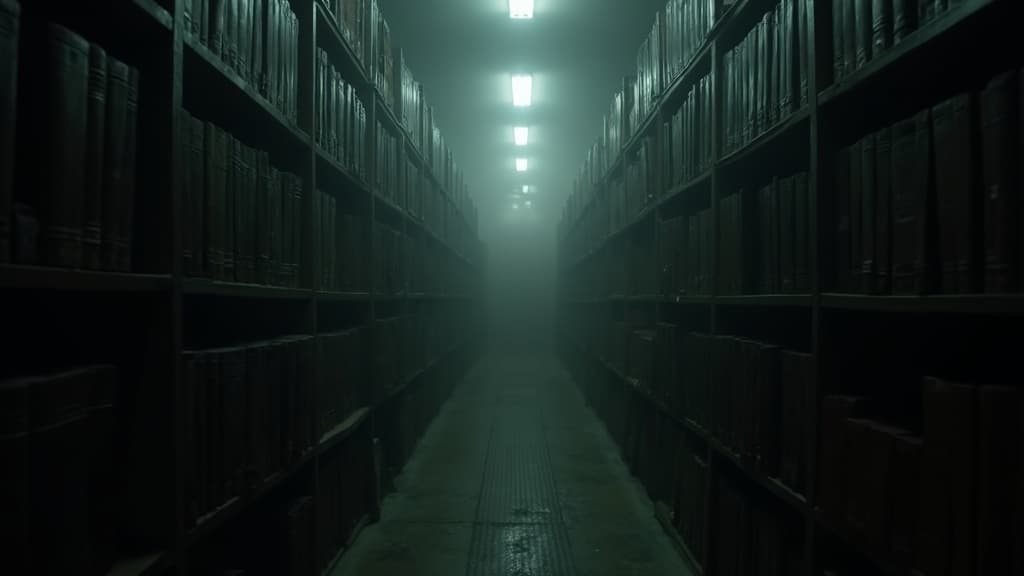
SCPG-039 is contained in situ at its discovery location, Stack Level B-4 of the Maxim Gorky Scientific Library, Lomonosov Moscow State University. The room is a closed-access reserve archive originally established 11 September 1953 under the personal seal of T. D. Lysenko and never formally decommissioned. Foundation containment leverages the archive's existing institutional invisibility; under no circumstances is the room's status to be formally altered, audited, or transferred, as such an action would require declassification of its 1953 sealing order and create an extra-Foundation paper trail.
Foundation personnel assigned to SCPG-039 maintain cover identities as the Russian Academy of Sciences Manuscript Conservation Detachment No. 14 (RAN-MCD-14). The cover designation predates Foundation involvement and was retained intact. All assigned personnel must hold genuine credentials in paper conservation, Soviet-era bibliography, or both, and must publish at least one (1) peer-reviewed conservation paper per calendar year in order to sustain the cover.
The archive is to be maintained at 14.0 °C (±0.5 °C) and 47% relative humidity. These environmental parameters were established by the original 1953 ventilation specification and are to be preserved without modification; experimental adjustment of the room's climate is prohibited under Standing Order LYSENKO-9 following the events of 14 April 2007 (see Addendum SCPG-039.3).
Access to Stack Level B-4 is restricted to personnel holding Level 3/039 clearance and currently rostered to the active reading cohort, which is not to exceed four (4) individuals at any time. The reading cohort is to be rotated on a 90-day cycle. No researcher may serve consecutive rotations. No researcher may serve more than three (3) total rotations in their lifetime.
The following protocols govern interaction with SCPG-039 instances:
-
Protocol GLAGOLITSA-A (Query Discipline). Personnel entering Stack Level B-4 may not formulate, vocalize, subvocalize, or hold in working memory any specific research question, hypothesis, or factual query during their time in the room. Personnel are to perform only catalog maintenance, binding inspection, and shelf-order audits. A pre-entry meditation period of no less than twelve (12) minutes is required, supervised by the on-duty Cognitive Hygiene Officer.
-
Protocol GLAGOLITSA-B (Closed Reading). When a controlled reading is authorized, the reader is to be supplied with a pre-printed query slip stamped by the Site Director. The reader may open only the volume indicated and may read only the pages indicated. All reading is to be conducted aloud in Russian, with a second researcher transcribing by hand on acid-free paper. No photographic or digital reproduction is permitted within Stack Level B-4 (see Addendum SCPG-039.2).
-
Protocol GLAGOLITSA-C (Citation Quarantine). Any external scientific publication that cites, paraphrases, or replicates a finding traceable to a SCPG-039 instance is to be flagged in the Citation Watch Index maintained at Site-19. Flagged papers, their authors, and their institutional affiliations are to be monitored for a minimum of ninety (90) days from publication. Replication studies originating in flagged citation chains are not to be obstructed.
The 1,847 bound monographs comprising SCPG-039 are not to be removed from Stack Level B-4 under any circumstance. Twelve (12) attempts at controlled removal between 1971 and 1994 are documented; in each case, the removed volume's contents underwent rapid degradation to blank pages within 4 to 17 minutes of crossing the room's threshold, while a matching volume reappeared on its original shelf within the same interval. The mechanism of reappearance has not been observed.
Personnel are reminded that, in accordance with Standing Order LYSENKO-3, no attempt is to be made to destroy, burn, shred, deacidify, or otherwise permanently damage any SCPG-039 instance until the implications outlined in Addendum SCPG-039.6 have been resolved by the O5 Council. As of the most recent review (██/██/2024), no such resolution has been issued.
Description
SCPG-039 designates a collection of 1,847 bound scientific monographs housed on Stack Level B-4 of the Maxim Gorky Scientific Library at Lomonosov Moscow State University. The volumes occupy 84 linear meters of original steel shelving manufactured at the Stalingrad Metallurgical Combine and bear classmarks conforming to the Cyrillic Dewey variant promulgated by the Soviet Academy of Sciences between 1948 and 1956. The shelving, the lighting fixtures, the cataloging cards, and the small wooden reading desk at the south wall are all consistent with the room's official sealing date of 11 September 1953.
Individually, each volume appears to be a routine scientific or technical monograph of the mid-twentieth century. The bindings are buckram or pebbled cloth in the muted greens, browns, and oxblood reds characteristic of Soviet academic publishing. The paper stock is standard GOST 1342-71 wood-pulp, slightly acidic, browning at the edges as expected for material of this age. The typesetting is consistent with hot-metal Linotype work performed at the Pravda Printing Combine and at the Lenin Press, Leningrad. Cursory examination reveals nothing irregular.
The anomalous property of SCPG-039 manifests only under specific conditions of intentional inquiry. When a reader enters Stack Level B-4 holding a sincere, unanswered scientific question — designated the query state — and selects a volume whose nominal subject is adjacent to that question, the volume's contents are, upon opening, found to contain a direct, substantive, and apparently authoritative answer to the query. This answer is accompanied by:
- A complete chain of citations to prior literature, all of which exist and all of which, upon retrieval, are found to corroborate the result;
- Tabulated experimental data of a precision and granularity consistent with the methods of the volume's stated period;
- Acknowledgements, peer review correspondence, and editorial marginalia consistent with the publication history of the host journal or press;
- Where relevant, photographic plates, diagrams, and apparatus schematics rendered in period-appropriate halftone or line engraving.
The answer is correct.
It is correct not in the sense that it accurately describes the state of scientific knowledge at the time of inquiry, but in the stronger sense that, within a window of thirty (30) to ninety (90) days following the reading, the answer becomes demonstrably consistent with the broader scientific literature in the relevant field. Replication studies succeed. Independent experiments performed at unaffiliated institutions yield results matching the SCPG-039 figures to within instrument tolerance. Existing publications that contradict the SCPG-039 result are quietly corrected, withdrawn, or — in a non-trivial number of cases — found upon re-examination never to have stated what witnesses recalled them stating.
The Foundation's working model designates this property retrocausal citation propagation. The mechanism is not understood. What is understood is the topology of its consequences: every reader of an SCPG-039 instance becomes, within their next published work, an unwitting vector. Their citation of the Glagolev result enters the literature; peer reviewers accept the citation because the underlying volume exists and is reachable through interlibrary loan summary; secondary authors cite the secondary author; within two to three publication cycles the result is treated as established background knowledge, and the original SCPG-039 reading has become invisible.
Approximately 14% of the 1,847 monographs treat subjects that did not exist as recognized fields of inquiry at the time of the volumes' physical binding. Confirmed examples include:
- Cellular Editing by Repurposed Microbial Endonucleases: Methods and Applications, A. P. Glagolev and N. S. Bobrov, Izd. AN SSSR, Moscow, 1957. 312 pages. Subject matter substantively identical to what is now termed CRISPR-Cas9 gene editing.
- Foundations of Polynomial-Time Algorithms on Reversible Quantum Registers, V. K. Glagolev (no relation), Lenizdat, 1962. 198 pages. Contains the Shor factoring algorithm in non-anglicized notation, with priority claimed for one Sh. R. Karpov of the Steklov Institute.
- Asymmetric Hydrogenation by Chiral Rhodium-Phosphine Complexes, anonymous, Khimiya, 1959. 247 pages. Describes the Noyori synthesis in detail. The Russian-language preface thanks the laboratory of "R. Noiri, Nagoya" for unspecified consultation.
- On the Spectra of Three-Degree Gravitational Wave Sources in the Decihertz Band, B. M. Glagolev, Nauka, 1968. 156 pages.
- Geometric Methods in the Analysis of Trained Multi-Layer Perceptrons, M. I. Glagolev, Izd. MGU, 1971. 89 pages.
The recurrence of the surname Glagolev across volumes of disparate subject matter and putative authorship has not been explained. Genealogical searches in Soviet academic registries return either no record of these individuals or records that, upon re-verification one week later, no longer exist. The Foundation designates the entire collection by this surname as a matter of internal convenience; it is not believed to refer to any specific historical person.
The dread implied by SCPG-039 is not located in any single volume. It is located in the question of how many of the citations comprising contemporary scientific consensus originate, traceably or otherwise, in a reading performed on Stack Level B-4 between 1953 and the present. This question is, by the anomaly's own mechanism, not answerable: any audit of the citation record that attempted to identify Glagolev-descended results would, in the act of formulating the audit, generate additional Glagolev-descended results indistinguishable from the rest of the literature.
Addendum SCPG-039.1: Discovery and Initial Containment
Foundation attention was drawn to Stack Level B-4 on 4 March 1971 following a letter of complaint forwarded through Soviet academic channels and intercepted by Foundation asset GRANIT-7. The complainant, a doctoral candidate in theoretical physics named Lev Iosifovich Brodsky, alleged that a monograph he had consulted in the Lomonosov reserve room on 19 February 1971 contained an experimental result that he was certain had not been in the volume when he consulted the same passage on 11 February. Brodsky's letter included photocopies of his own contemporaneous handwritten notes from both visits.
The notes differed.
The 11 February notes recorded the volume's discussion of a particular cross-section measurement as inconclusive, with the author calling for further experimental work. The 19 February notes recorded the same passage as reporting a precise figure of (3.41 ± 0.07) × 10⁻²⁷ cm², with full apparatus description. Brodsky stated that he had returned to the volume specifically because he had thought of an experimental approach to resolve the open question, and had wished to confirm that the question was indeed open before applying to his thesis committee for funding. He found, instead, that it had already been answered, by a 1956 monograph, in terms identical to the experiment he had been planning to propose.
Brodsky was administered Class-B amnestics on 7 March 1971 and reassigned to a teaching position at Irkutsk State University, where he had a productive if unremarkable career and died of natural causes in 2003. The cross-section figure he had inadvertently caused to be recorded is now standard in particle physics handbooks. It has been independently re-measured at four facilities, most recently in 2019, and each measurement has agreed with the Glagolev value.
Initial Foundation containment, designated Provisional Operation GRANIT-LIBRARY, treated the room as a Type-IV memetic environment and recommended sealing. The recommendation was overruled by the Russian Sector Director on the grounds that destruction of the volumes might, by the same retrocausal mechanism, propagate backward through the existing citation record and produce arbitrarily large alterations to consensus reality. The decision to preserve SCPG-039 in situ has been ratified at each O5 review since 1974.
Addendum SCPG-039.2: Reading Log, Excerpt
The following is excerpted from the operational log of Dr. Yelena Sergeyevna Krasnova, Senior Researcher and Cognitive Hygiene Officer, Site-241. Dr. Krasnova has been continuously assigned to SCPG-039 since 1998 and is one of two personnel granted Standing Exception to the three-rotation rule on the basis of irreplaceable institutional knowledge. She holds a candidate's degree in bibliography from MGU (1989) and a doctorate in the history of Soviet science from the European University at St. Petersburg (2003).
11 October 2022. Controlled reading No. 4471. Query slip authorized by Site Director Volkov: "Mechanism by which methanogen archaea regulate F420 cofactor biosynthesis under low-temperature anaerobic conditions." Reader: J. Halberstam, visiting from Site-19. Transcriber: myself.
Halberstam selected volume B-4/IV/22/7, Glagolev (P. T.), Biokhimiya Anaerobnykh Mikroorganizmov Severnykh Pochv, Izd. AN SSSR, 1954. The volume opened, as they always do, to the page the reader needed. Pages 188 through 203. A complete description of the cofactor pathway, including the role of a previously unidentified flavoprotein chaperone, with kinetic constants to four significant figures. Halberstam read aloud in clear Russian, occasionally pausing on technical vocabulary. I transcribed. Reading concluded 14:41 local time.
I want to record here, off the formal protocol, what it is like to be in the room during a reading. The volumes do not glow. The air does not change. There is no sound. There is, however, an effect that I have failed for twenty-four years to describe to my superiors in a way that does not sound like superstition. As the reader speaks, I have the sensation that the sentence being read is being heard by something other than me, and that this something is making a note. Not the volume. The volume is, by then, only paper. The note is being made elsewhere.
Halberstam closed the volume and returned it to the shelf. He thanked me. He said it had been a productive consultation. He will fly back to Site-19 tomorrow and, within the next six months, his name will appear on a paper in Nature Microbiology, and the F420 chaperone will be the chaperone, and I will be the only person in the world who remembers a week, in February of 2019, when a graduate student at ETH Zürich named Annika Vogt published a paper demonstrating that the chaperone did not exist.
Vogt's paper is no longer in the literature. I have searched. The DOI resolves to an erratum. I requested a printout from my own pre-2019 records and it arrived blank.
Addendum SCPG-039.3: Incident 039-2007-04 ("The Climate Test")
On 14 April 2007, then-Junior Researcher M. A. Sokolov, acting without Site Director authorization, raised the temperature of Stack Level B-4 from the standard 14 °C to 21 °C over a six-hour period. Sokolov's stated objective was to test the hypothesis, then current among the research staff, that the room's specified environmental conditions were a Lysenko-era operational requirement rather than a paper-preservation measure, and that altering them might disrupt or attenuate the anomaly.
At the conclusion of the temperature ramp, Sokolov opened a randomly selected volume (B-4/II/9/14, Mendel'evskaya Genetika i Pшenitsa [Mendelian Genetics and Wheat], anonymous, Selkhozgiz, 1955) and read aloud a query previously verified by external means to be false: that the wheat variety Bezostaya 1 had been bred not by P. P. Lukyanenko at the Krasnodar Agricultural Institute, but by one A. I. Grebenkin at the Lysenko Institute of Agrobiology in 1947, using methods consistent with Lysenkoist "vernalization" rather than orthodox Mendelian selection.
The volume contained the answer Sokolov had vocalized.
Within forty-one (41) days, three independent Russian-language agricultural-history publications had been amended to credit Grebenkin. By day sixty-three (63), the English-language Wikipedia article on Bezostaya 1 had been edited by twelve distinct accounts, none Foundation-affiliated, to reflect the new provenance. By day eighty-eight (88), the Krasnodar Agricultural Institute's own institutional history had been quietly revised; Lukyanenko's name now appears on the cultivar only as a "verification breeder" working from Grebenkin's original lines.
Foundation efforts to restore the correct historical record have been unsuccessful. Personnel who recall the pre-incident attribution can be identified by polygraph but cannot produce documentary evidence; documentary evidence, when produced from sealed Foundation archives, is found upon re-examination to have always credited Grebenkin.
Sokolov was reprimanded, transferred to administrative duty at Site-19, and is no longer authorized to enter Stack Level B-4. The Standing Order LYSENKO-9 prohibition on climate experimentation dates from this incident.
The implications of the incident — that the anomaly produces correct answers regardless of the truth-status of the query, and that "truth-status" itself appears to be a downstream consequence of SCPG-039 readings rather than an independent constraint — are addressed in Addendum SCPG-039.5.
Addendum SCPG-039.4: Personal Notes, Dr. Y. S. Krasnova
The following document was found among Dr. Krasnova's working papers following her 90-day mandatory psychological evaluation in March 2024. It is included in the file at her request and with her authorization.
I want to write this down while I still believe it is the kind of thing one writes down.
My candidate's dissertation, defended in 1989, was on the bibliographic methodology of late-Soviet agricultural science. The work was unremarkable; it earned me a position at the Institute of Scientific Information, which is where the Foundation recruited me in 1998. I have always understood my career as the product of my own labor.
Last month I requested, through internal channels, the full bibliography of my 1989 dissertation. I cross-referenced every cited work against the SCPG-039 catalog. There are no matches. Of course there are no matches; the SCPG-039 catalog records the volumes' nominal subjects, not the secondary literature they have produced.
So I did the harder thing. I requested the citation network — the works cited by my citations, and the works cited by those, to a depth of five. I had this prepared by the analytics team at Site-19 under the cover of a methodology paper on Soviet citation practices.
At depth three, one of my foundational citations — a 1961 paper by V. M. Ivanchenko on the bibliometric properties of agricultural extension publications, a paper without which my own methodology does not function — cites a 1958 monograph by P. T. Glagolev.
I do not know whether Ivanchenko ever entered Stack Level B-4. I have no way to know. He died in 1979. His own bibliographic notes, held at the Russian State Library, were destroyed in a 1986 flood. The Glagolev monograph he cites exists. It is on my shelf. I have walked past it perhaps four thousand times.
What I want to say, and what I have been unable to say in the formal reports, is this: there is no version of the question "is my work my own" that has a meaningful answer in a world that contains SCPG-039. The work is mine. The methodology was mine. The dissertation was defended by me in a room in Moscow in front of a committee who asked me hard questions. And one of the books that made the methodology possible may have been written by something that lives in the basement where I now work.
I do not know what to do with this. I am writing it down because the alternative is to stop writing things down, and I am not yet prepared to do that.
— Y. S. K., 19 February 2024
Addendum SCPG-039.5: The Falsifiability Problem and Provisional Reclassification Review
Following Incident 039-2007-04, the Site-241 research team formally raised the question of whether SCPG-039 satisfies any conventional test of anomalous behavior. The standard Foundation methodology — establish a baseline, perturb, observe deviation — depends on the existence of a stable referent against which to measure change. SCPG-039 does not permit such a referent. Any baseline established prior to a reading is, after the reading, found to have always agreed with the reading's result. Any record of the previous baseline is, after the reading, found never to have existed in the form remembered.
The research team has proposed three (3) interpretations:
Interpretation A (Retrocausal Editing). The anomaly modifies the past, including the contents of records, the memories of researchers other than those directly exposed, and the outcomes of past experiments. Under this interpretation, the universe contains a coherent, single, modified history at all times, and human disagreement about prior states reflects the imperfect propagation of the edit across observer memory.
Interpretation B (Ontological Generation). The anomaly does not modify the past. It generates a present in which the queried result is, going forward, true. The universe's prior history is unchanged but inaccessible; what is accessed in its place is a newly instantiated history consistent with the new present. Under this interpretation, the room is producing universes at a rate of approximately three to fifteen per controlled reading session.
Interpretation C (Selection). The anomaly selects, from among an ensemble of possible histories, the one in which the queried result is true and in which the reader's reading caused it. Under this interpretation, every reader of an SCPG-039 instance is — across the ensemble — both the cause of a scientific result and the discoverer of it, and there is no fact of the matter as to which.
The Site-241 team has been unable to design an experiment that distinguishes among these interpretations. The Provisional Reclassification Review Board has, at each of its biannual meetings since 2012, declined to elevate SCPG-039 to Keter on the grounds that the anomaly is geographically fixed, mechanically understood at the operational level, and has produced no documented case of physical harm to personnel or civilians.
Dr. Krasnova's dissenting opinion, filed at the November 2023 review, is preserved here in full:
The classification system assumes that we know what damage looks like. SCPG-039 does damage that erases itself. We will never see the body. We are not going to find a victim of this anomaly, because the anomaly's victims will, by the time we look, be people for whom the result was always true. I include myself in this category. I include, with greater apprehension, all of you.
The argument for Euclid is that the room is in a building we control. The argument for Keter is that we have no way to verify that we ever controlled it, or that the building is in fact in Moscow, or that there has ever been a year in which the contents of this archive did not include whatever volume any subsequent reader needed it to include. I am not asking the Board to reclassify on the basis of what we know. I am asking the Board to consider that the category of things we know is, in this case, a category SCPG-039 has been allowed to define for itself.
The Board's response is on file.
Addendum SCPG-039.6: The Lysenko Question
The provenance of Stack Level B-4 — sealed in 1953 under the personal authority of T. D. Lysenko, three months before his political ascendancy began to fracture and seven months before the death of I. V. Stalin — has been the subject of internal debate since the room's discovery. The Foundation working hypothesis, current as of this writing, is as follows.
Trofim Denisovich Lysenko was, by the documentary record, a man who built his career on the suppression of an entire scientific field and the elevation of methods that did not work. He sent Mendelian geneticists to die in the camps. He destroyed the discipline of Soviet biology for a generation. The conventional explanation for his durability is political — that he had Stalin's ear, and that the Soviet scientific establishment lacked the independence to oppose him.
The conventional explanation is sufficient. It does not require supplementation.
The non-conventional explanation, which has been raised internally and which the O5 Council has declined to formally address, is that Lysenko's theories worked, for as long as he was able to ensure that the relevant questions were asked in a particular room in Moscow, of a particular set of books, and that the answers were then published in journals he controlled. Under this explanation, the failure of Lysenkoism after 1953 is not the discovery that it had always been wrong, but the consequence of an interruption in citation flow — the sealing of the room — after which the propagation mechanism could no longer maintain consistency between the published literature and the experimental record.
If this explanation is correct, then SCPG-039 was sealed by the man who built it, at the moment he understood that he was losing the political capacity to keep it running, in order to preserve the option of restarting it later.
The Foundation has not restarted it. The Foundation has, instead, used it — through the controlled-reading program — at a rate of approximately fifty (50) authorized queries per year since 1974, primarily in support of medical, agricultural, and materials-science research considered to be of strategic value.
The internal review board of the controlled-reading program has, on each occasion of its convening, found the program to be in compliance with applicable ethical guidelines.
Standing Order LYSENKO-3 prohibits destruction of any SCPG-039 instance pending resolution of the question of whether the citation record produced by Foundation use of the archive can be safely disentangled from the citation record produced by all other use of the archive, across all of its operational history, by all parties.
No such resolution has been issued. None is expected.
Closing Note
The following inscription was found on 7 January 2024, written in pencil on the inner cover of volume B-4/I/3/22 (Osnovy Klassicheskoi Termodinamiki Neravnovesnykh Protsessov, Glagolev, P. T., 1956), in handwriting that the Site-241 graphology team has provisionally identified as that of T. D. Lysenko. The inscription was not present at the volume's most recent prior inspection (3 January 2024). It is dated 12 September 1953 — one day after the room's official sealing.
Если книга знает ответ, то и мир его узнает. Будьте осторожны с тем, что вы спрашиваете.
[If the book knows the answer, the world will know it too. Be careful what you ask.]
Open Questions
- By what mechanism does the SCPG-039 mechanism propagate corrections through the wider scientific literature without observable agency?
- Why does the surname Glagolev recur?
- Which of the questions in this document was asked first, and which is its answer?
Document Classification: Level 4/039
Unauthorized access is monitored, logged, and — where the access constitutes the formulation of a query — may itself constitute a containment breach. Report all unscheduled curiosity to the on-duty Cognitive Hygiene Officer.