AUDIO RECORD — LEVEL 2 CLEARANCE
SCPG-040: The Hachiōji File
Item #: SCPG-040
Object Class: Safe
Site of Containment: Site-227 (Foundation Records Annex 227-C, Ōme, Tokyo Prefecture, Japan)
Threat Level: ████ (White)
Special Containment Procedures
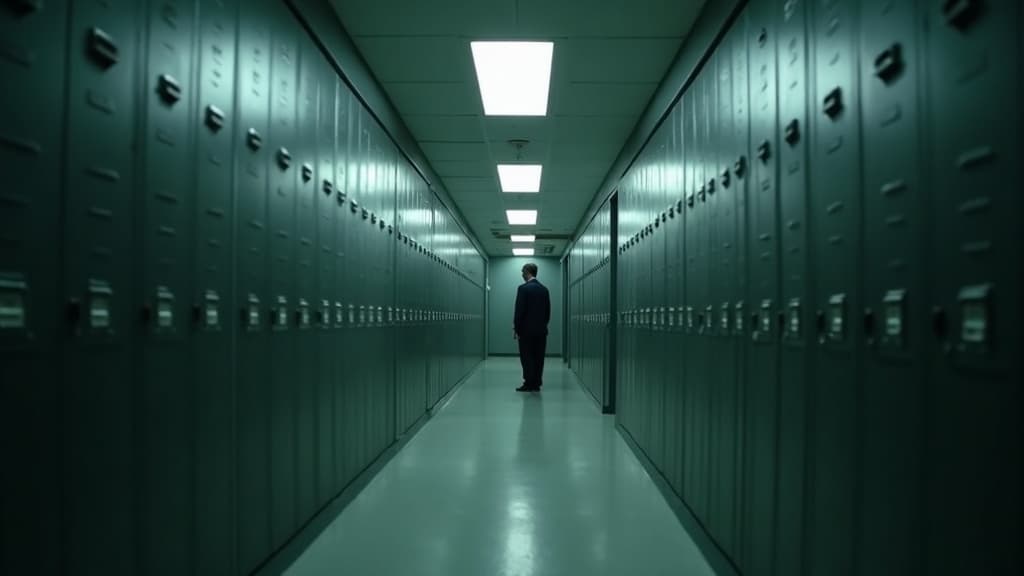
SCPG-040 is stored in standard document locker 40-C, Row 11, of Records Annex 227-C. The locker is unmodified commercial stock (Kokuyo, 1979 pattern) and requires no environmental control beyond that provided to the annex generally. The key is held by the duty archivist. No secondary security measures are authorized, funded, or required.
Physical inspection of SCPG-040 is conducted quarterly. Inspection is limited to: weighing of the binder; measurement of spine width; mechanical page-edge count performed by fanning under an unrecorded camera feed with the display oriented away from the inspecting archivist. The contents of SCPG-040 are not to be read. Photography, photocopying, scanning, transcription, and translation of any page are prohibited. The most recent authorized reading of SCPG-040's contents concluded 11 October 2007 (see Addendum 040.3).
Personnel assigned to SCPG-040 are selected under Protocol KEIZOKU for low investigative disposition, as measured by the Site-227 Inferential Aptitude Inventory. Personnel with backgrounds in law enforcement, journalism, insurance adjustment, or historical research are ineligible. Assigned personnel may not consume media of any kind concerning the 1986 disappearance of Sonoda Rie, and must file an annual attestation, witnessed by the Site Director, stating: "I have formed no conclusions regarding Tokyo Metropolitan Police Department case 61-1124." Personnel unable to sign this attestation in good conscience are to be rotated out of assignment without penalty and without debriefing on the reasons for their inability.
Under Standing Order KEIZOKU-1, no Foundation employee, contractor, asset, or embedded agent may investigate, theorize about, model, or attempt to solve the disappearance of Sonoda Rie. Hypothesis formation concerning the case is classified as an unauthorized interaction with SCPG-040 regardless of the physical location of the person forming the hypothesis.
In the civilian world, TMPD case 61-1124 remains administratively open, designated a special missing-persons matter, and assigned to no active investigator. Foundation asset ██████, embedded in the TMPD First Investigation Division records section, ensures that the case's mandatory annual review is conducted as a documentary formality and that no personnel-hours are allocated to it. Web monitoring task WATARIDORI flags public discussion of the case; flagged individuals are discouraged by mundane administrative means (denial of records requests, non-renewal of press credentials, attrition of sources). Amnestic intervention has been authorized twice since 1991 and used once.
Personnel are reminded that these procedures are substantially self-executing. SCPG-040 has never breached containment, because SCPG-040 is the containment. The procedures above exist to contain Foundation personnel.
Description
SCPG-040 is a kraft-paper expanding case binder of the type issued to Tokyo Metropolitan Police Department stations in the late Shōwa period, closed with a cotton tie-cord and bearing the original cover sheet of Hachiōji Police Station investigation file 61-1124: the disappearance of Sonoda Rie, aged fourteen (14), third-year student at Hachiōji Municipal ████ Junior High School, last seen on the evening of Wednesday, 12 November 1986, on the pedestrian overpass spanning the Chūō Line tracks approximately 600 meters from her home. A witness walking a dog placed her alone at the midpoint of the overpass at approximately 16:50, facing west along the tracks, in school uniform, carrying a badminton club sports bag. Neither Sonoda Rie, nor the bag, nor any article of her clothing has been recovered. No body was found on the right-of-way. No train strike was reported that evening. The case generated substantial investigative activity through 1988 and has generated none since.
The binder's cover, tie-cord, internal dividers, and original 1986–88 contents are materially unremarkable. Papers are period-correct wood-pulp and mimeograph stock; typescript is consistent with the kana typewriters in service at Hachiōji Station in the relevant years; hanko seal impressions match registered exemplars of the officers named.
At Foundation intake on 20 March 1991, SCPG-040 contained 468 pages. At the most recent quarterly inspection (14 April 2026), it contained 1,514. No insertion of pages has ever been observed, recorded, or interrupted, including during continuous instrumented observation totaling 3,100 hours (1993–1996). New pages, when identified by edge-count differential, are found already bound in correct chronological position, materially aged in a manner consistent with their internal dates, and indistinguishable by any forensic method from the original 1986–88 contents.
The anomalous property of SCPG-040 is as follows. When any person reaches a true conclusion regarding case 61-1124 — a justified belief, however arrived at, that corresponds to fact — SCPG-040 is found upon next inspection to already contain that conclusion, formatted as an investigative lead of the appropriate period: opened, worked, documented, signed, sealed, and closed as exhausted, under a date years prior to the conclusion's formation. The closure documentation is procedurally complete. It records interviews conducted, records checked, alibis confirmed, and grounds for termination of the line of inquiry. Where the closure cites external records — station duty rosters, interview logs, train timetables — those external records, when checked, corroborate the lead's existence and disposition. Whether the external records were altered or were always as found has not been determined and is not, under current procedures, a question any Foundation employee is authorized to pursue.
False conclusions produce no insertion. This asymmetry was confirmed experimentally in 2006–2007 (see Addendum 040.3) and constitutes the file's only known failure of discretion: SCPG-040 functions, incidentally, as a verifier of truth concerning the case it contains. The Foundation's brief attempt to exploit this property is documented below. The attempt was terminated. It will not be resumed.
Page-growth continues at a mean rate of 2.6 pages per year during periods in which no monitored individual is known to be thinking about the case at all. The Foundation's working interpretation is that unmonitored persons — retired police officers, aging witnesses, readers of old newspapers, the woman who saw a girl on an overpass forty years ago and still, some evenings, wonders — occasionally arrive at true conclusions, and that each such arrival is received, dated backward, signed, and closed.
The implication is arithmetical rather than speculative. Any true conclusion that will ever be reached about the disappearance of Sonoda Rie is already in the file. This includes the true and complete account of what happened to her on the evening of 12 November 1986. That account exists, somewhere in the 1,514 pages currently in locker 40-C, in period typescript, over an authentic seal, marked exhausted. It is correct. It has been correct since before anyone knew it. The case cannot be solved, because to solve a case is to arrive at the truth first, and with respect to case 61-1124 it is not possible to arrive first. The file is always already there, waiting at the end of every line of inquiry with the line's conclusion in hand, stamped, and filed.
Sonoda Rie remains a missing person. She is also, within Foundation administration, a component attribute of an object number. The Classification Review Board is aware of both facts. See Addendum 040.5.
Addendum 040.1: Discovery and Initial Containment
The original investigation was led from November 1986 by Assistant Inspector Oda Shigeru of Hachiōji Station, seconded to the case from the community safety division after the First Investigation Division declined jurisdiction in the absence of evidence of a crime. Oda worked the case with diligence disproportionate to its staffing: 211 interviews, canvasses of the overpass approach on fourteen consecutive Wednesdays, correspondence with every station on the Chūō Line between Tachikawa and Takao.
On 3 March 1988, Oda drafted a memorandum proposing a new line of inquiry involving the delivery route of a beverage wholesaler whose truck had been serviced at a garage near the overpass. Before filing it, he consulted the case binder to confirm the lead was novel. He found it at divider 7: lead L-141, opened 5 January 1987, worked for eleven days, closed as exhausted — over his own seal. Oda had no memory of the lead. His own duty log for January 1987, retrieved from station records, showed him detailed to the interviews the lead described.
Oda reported the discrepancy to his superiors. He was referred for medical evaluation, found fit, and transferred to a kōban posting in Kunitachi effective June 1988. His 1990 letter of complaint to the National Police Agency inspection bureau — in which he stated, with a plainness his evaluators read as pathology, that "the file is finishing the investigation before I can conduct it" — was intercepted by Foundation asset TSUBAME on 8 February 1991.
Foundation intake proceeded on 20 March 1991. The original binder was removed from Hachiōji Station and replaced with a 34-page mundane replica sufficient to sustain the case's open administrative status. No TMPD personnel noticed the substitution. No TMPD personnel have consulted the replica since 1994.
Oda Shigeru was not amnesticized. Foundation review determined that every conclusion he had reached or would plausibly reach was already contained in SCPG-040 as a closed lead, and that he therefore constituted no vector. He retired in 2004. Surveillance notes (discontinued 2011 as an unjustifiable expense) record that he visited the overpass each year on the evening of 12 November, stood at the midpoint for between four and eleven minutes, and left. He was not observed to speak of the case again. He died in Kunitachi in March 2021.
Sonoda Kimie, the missing girl's mother, still resides in the family apartment in Hachiōji. Each spring she reprints the missing-person notice and delivers copies to the station, where they are accepted, stamped as received, and filed. In 1992 she wrote to the station that her daughter "would not have spoken to a stranger; whoever it was, Rie knew them." SCPG-040 contains her letter. Four dividers earlier, it also contains lead L-088, opened 19 February 1987 and closed 4 March 1987, which reaches the same conclusion, documents its investigation, and marks it exhausted. Her grief, too, had been anticipated, worked, and filed before she expressed it.
Addendum 040.2: Forensic Document Summary and Growth Log
Excerpted from Site-227 technical report 040-TR-9 (consolidated 2019):
Paper stock, adhesives, staple alloys, mimeograph and carbon inks, seal vermilion, and typeface wear patterns of all sampled insertions are consistent with genuine TMPD documentary practice of the dates they bear. Accelerated-aging signatures are absent. Fluorescence, fiber, and isotope analysis distinguish no inserted page from the verified 1986 originals. The documents are not forgeries in any sense available to forensic science; they are, materially, what they claim to be.
Electrostatic detection analysis (ESDA) of 62 sampled pages identified handwriting indentations — impressions transferred from sheets written upon while resting atop the sampled pages — corresponding to 41 documents that are not present in the file and that match no document in TMPD or Foundation records. The indented texts, where recoverable, are procedurally formatted lead reports concerning case 61-1124. Their lead numbers fall within ranges not yet observed in the binder. The file's contents, in other words, bear the physical impression of contents it has not yet disclosed, or has withdrawn, or maintains elsewhere.
Page counts at selected inspections:
| Date | Pages | Interval gain |
|---|---|---|
| 20 Mar 1991 (intake) | 468 | — |
| 12 Jan 1996 | 611 | +143 |
| 9 Oct 2001 | 702 | +91 |
| 11 Oct 2007 | 913 | +211 |
| 15 Apr 2013 | 1,088 | +175 |
| 10 Jul 2019 | 1,331 | +243 |
| 14 Apr 2026 | 1,514 | +183 |
The 2001–2007 interval includes the Directed Inquiry Program. The gain attributable to the Program's fourteen (14) queries is 88 pages. The remaining 123 pages of that interval, like the majority of all growth, correspond to no known act of deduction by any monitored person.
Addendum 040.3: Incident Report — Directed Inquiry Program (Terminated)
Between September 2006 and October 2007, the Site-227 research office, under Dr. R. Aizawa, conducted the only authorized program of deliberate interaction with SCPG-040. The program's premise: since true conclusions appear in the file and false ones do not, SCPG-040 could be used as an oracle. A hypothesis about the case would be formulated, held by a single cleared researcher, and the file inspected. Insertion confirmed truth; absence confirmed falsehood. In principle, a structured sequence of hypotheses could converge on the full solution of case 61-1124.
Fourteen queries were run. Summary findings:
- Every hypothesis confirmed true appeared as a closed lead dated 1987–1989, complete with closure rationale.
- Every closure rationale cited grounds that rendered the lead unpursuable in the present: the key witness deceased; the relevant business dissolved and its records pulped; the photographic negatives destroyed in the 1993 Fuchū records-warehouse fire. In each instance the cited destruction or death was verified against civil records and found to be factual.
- In nine (9) of fourteen cases, the destruction or death cited in the closure document postdated the closure document's own date — in one case by sixteen years. Lead L-217 (dated 9 February 1987) states that a witness "could not be re-contacted." The witness died in 2003. The query establishing the lead's subject matter was run in 2007.
Query 12 confirmed the following hypothesis as true: the person Sonoda Rie encountered on the overpass was known to her. The corresponding lead, L-217, records that the individual in question was identified, interviewed on 6 and 8 February 1987, and eliminated; the identifying particulars are given as an attachment reference. The referenced attachment is among the 41 documents detectable by ESDA impression but not present in the binder.
Dr. Aizawa's termination memorandum (2 November 2007) is excerpted here:
The oracle works. That is the finding, and it is the reason to stop. Each confirmation costs us the lead it confirms. The file does not merely record that a path was closed; the world, on inspection, agrees that the path is closed — the witness is dead, the record is ash — and we have no way to establish whether our query found this state of affairs or furnished it. Convergence modeling estimates 180 to 260 further queries to specify the full solution. If even a fraction of the associated closures are furnished rather than found, we would arrive at a truth that our own arrival had made permanently unverifiable, at a cost we are not able to compute, in a currency we have not identified.
I am recommending termination on those grounds. I record, for honesty's sake, that the Board's draft concurrence memo gives different grounds, and quotes them from budget guidance: "a solved cold case has no custodian; an unsolvable case is a stable case." I have been asked to note that the two rationales are compatible. They are. That is the part I would ask the reader of this file — whoever, whenever — to sit with.
The program was terminated 11 October 2007. Standing Order KEIZOKU-1 dates from this incident. Dr. Aizawa accepted transfer to Site-19 in 2008 and, per the terms of the transfer, was administered a targeted Class-C amnestic covering the content, though not the fact, of queries 12 through 14.
Addendum 040.4: Duty Log, Senior Archivist Imai Kaoru
Senior Archivist Imai has been assigned to SCPG-040 since 2014. She came to the Foundation from the National Police Agency archive division, where she spent nineteen years accessioning closed files; her Inferential Aptitude Inventory score is the second-lowest ever recorded at Site-227, a fact noted in her assignment letter as a qualification. The following entries are excerpted, with her consent, from her quarterly duty log.
14 July 2023. Inspection complete. Weight 4.94 kg, spine 128 mm, edge count 1,412. Gain of 7 since April. I logged the numbers and re-tied the cord. The cord is the original cotton and it is going soft at the knot from forty years of hands, some of which existed.
People ask what the discipline is like. It is like carrying a full cup down a corridor. You do not think about the cup. You think about the corridor. I count in my head while I handle the binder — not the pages, just counting, two hundred, three hundred — because a mind that is counting is not concluding. The Inventory people say I have "low investigative disposition," which is an expensive way of saying I have spent my whole working life filing other people's questions without asking my own. It turns out that was a skill. It turns out somebody was eventually going to pay for it.
13 October 2023. Attestation season. I signed mine: I have formed no conclusions regarding case 61-1124. The Director witnessed it. Every year I sign it and every year it is true, and every year it takes something to make it true. Because I know one thing about the girl that is not a conclusion, only a fact from the intake summary, which I was required to read in 2014 and have not read since: she was on the overpass at dusk, facing west along the tracks. In November the sun goes down along the Chūō Line like it is being pulled down a wire. Anyone who has stood on any overpass in west Tokyo in November knows exactly what she was looking at. That is not a conclusion. I have checked with the compliance office. Knowing what the sky looks like is not a conclusion.
12 April 2024. Inspection. Gain of 6 since January. I will record something here for the file, because the file is where things go.
In February, at home, not on duty, I was rinsing rice and I thought: the bag was never found because— and I stopped. I put the pot down and I counted to four hundred. I do not know how the sentence ended. I have made sure I do not know. Today the binder is six pages heavier and I have no way to learn whether one of those pages is mine — whether somewhere in there is a lead, dated 1987, sealed by a Hachiōji officer, that finishes my sentence about the bag and marks it exhausted. I am not going to look. That is the whole of the job, in the end. The job is to hold a thing that knows, and not to ask it.
The mother came to the station again this spring — the asset's report crosses my desk, one paragraph a year. She is eighty-one. The new posters use the same photograph, because there will never be a newer photograph. The station accepts them and stamps them received. I want to write that somebody should tell her something, and I have sat here for a while now, and I cannot finish that sentence either, because everything true that anyone could tell her is already in my locker, closed, and everything else would be a lie.
Addendum 040.5: Incident 040-2019-A ("Self-Filing") and Classification Review
During the 10 July 2019 inspection, the mechanical edge-count camera captured, incidentally and against procedure, a legible frame of page 1,289. Review of the frame under Ethics Committee waiver established that page 1,289 is a reformatted copy of the Foundation's own 1991 intake report for SCPG-040 — rendered in period TMPD documentary style, designated lead L-334, dated 14 June 1989 (twenty-one months before Foundation involvement began), sealed with the personal hanko of then-Site Director Kuroda (verified authentic against exemplar), and closed with the notation investigated; no continuation required.
Partial frames of adjacent pages captured fragments consistent with the structure, headings, and phrasing of the document you are currently reading. The fragments bear a lead number in a range not otherwise observed and a date in Shōwa 62 (1987). The Records Office is unable to determine which revision of this document the fragments correspond to, including whether the revision in question has been written yet.
The 2019 Classification Review Board considered three motions:
- Reclassification to Euclid, on the grounds that an object that has absorbed its own containment documentation as a closed lead has, in the only sense available, concluded its containment. Rejected, 5–1. The Board found that SCPG-040 has exhibited no expansion of scope beyond case 61-1124 in thirty-three years, and that the Safe class describes containment burden, not moral weight.
- Neutralization by incineration. Rejected unanimously. The effect of destroying the file is unmodeled. The Board's memorandum observes: "The object currently performs its own containment at zero marginal cost. Destruction would exchange a stable, self-limiting anomaly for an unknown, and would additionally reopen, in the only meaningful sense, a case which it is the entire function of present arrangements to keep closed without closing."
- A minority motion, filed by the Site-227 Ethics liaison, that the Foundation formally acknowledge in the object file that its containment strategy consists of ensuring that a fourteen-year-old girl is never looked for again by anyone, anywhere, in perpetuity, and that this strategy was selected primarily because it is inexpensive. Carried, 4–2, as to acknowledgment only. This paragraph constitutes the acknowledgment. No procedural change was ordered.
The Safe classification was affirmed and remains in force.
Closing Note
At the 14 April 2026 inspection, the edge-count differential localized a recent insertion to the front of the binder, ahead of the 1986 originals — the first anterior insertion on record. Under Ethics Committee waiver 040-W-11, a single page was photographed and read by one (1) researcher, who was amnesticized the same day per the waiver's terms.
The page is lead L-001. It is dated 12 November 1986, 21:40 — approximately five hours after Sonoda Rie was last seen, and two hours before her mother's missing-person report opened the case. The subject line is redacted in period ink. The lead is marked worked and closed the same evening. The closing seal matches no registered officer of the Tokyo Metropolitan Police Department, past or present. The disposition line reads:
確認済。継続の要なし。
[Confirmed. No continuation required.]
Document Classification: Level 2/040
Unauthorized access is monitored and logged. Personnel are reminded that reading this document is authorized and that drawing conclusions from it is not. Report all unresolved sentences to the duty archivist.